Operational agility isn’t just a management buzzword—it’s the new foundation for exceptional hospitality. In an era defined by shifting guest expectations, labor challenges and constant change, today’s most successful hotels aren’t simply reacting. They’re equipping frontline teams to anticipate, adapt and lead.
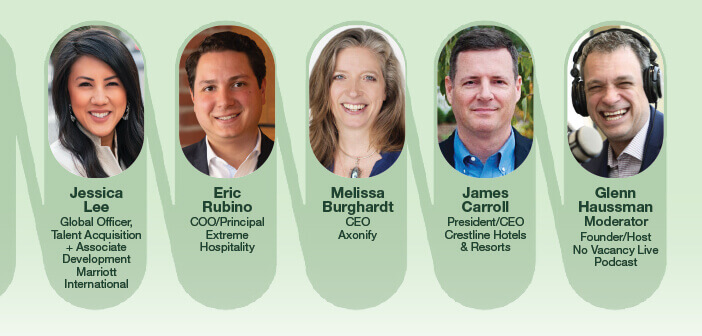
That was the focus of a recent Hotel Business Hot Topics discussion, “From Check-In to Checkout: The Key to Operational Agility and Guest Satisfaction,” in partnership with Axonify, which was moderated by Glenn Haussman, founder/host, No Vacancy Live podcast, and featured panelists Melissa Burghardt, CEO, Axonify; James Carroll, president/CEO, Crestline Hotels & Resorts; Jessica Lee, global officer, talent acquisition + associate development, Marriott International; and Eric Rubino, COO/principal, Extreme Hospitality.
Haussman opened the discussion by asking how agility takes shape inside a busy hotel. Carroll replied, “Operational agility means making sure our employees aren’t stuck behind a desk, buried in reports. They need to be out in the hotel—interacting with guests, engaging with their teams and responding to what’s happening in real time. When leaders and managers are present and connected, they can react to changes in demand, crises or opportunities. If everyone’s head is down in spreadsheets, there’s no agility.”
Implementing technologies that automate back-of-house tasks will help with getting staff in front of the guest instead of in front of a computer screen, noted Rubino, who added, “They need the tools and empowerment to make decisions in the moment—to adapt when something happens and take care of the guest standing right in front of them.”
That human connection, Lee pointed out, starts with empowerment. “You can’t have agility without empowerment,” she said. “If a guest service agent has to wait for approval to solve a problem, the moment is lost. Empowerment creates the confidence to act.”
She pointed to Bill Marriott’s “12 Rules for Success” as guidance for today’s leaders. “Those rules—‘see and be seen,’ ‘communicate by listening’ and ‘err on the side of taking action’—are all about being visible, listening and acting quickly,” she said. “That’s exactly what operational agility looks like in hospitality today.”
While empowerment drives confidence, that confidence must be supported from the top. Rubino stressed that true empowerment only works when leaders use mistakes as teaching moments, not punishments.
“Confidence comes from knowing you won’t get in trouble for making a decision,” he explained. “If leaders use empowerment moments as coaching opportunities rather than disciplinary ones, teams feel trusted—and that trust shows up in the guest experience.”
Burghardt agreed that empowerment and confidence are inseparable.
“A really wise person once told me: The guest experience can never exceed the team experience,” she said. “Adaptability comes from confidence. We focus on helping teams feel role-ready and prepared so that they can react to anything that comes their way.”
That sense of readiness, she explained, requires both technology and training. “Technology should make people more powerful, not more burdened,” she said. “It has to fit into the flow of work—taking away what’s mundane while amplifying what people do best.”
Carroll added that technology only drives agility when it simplifies, not complicates.
“One of the biggest things we try to avoid is having staff go through multiple systems just to do one task,” he said. “The fewer platforms they have to navigate, the more time they have to engage with guests.”
Rubino pointed out that it is imperative to involve frontline staff when deciding which technology to implement, especially since they are the ones using the platforms every day.
“Sometimes we roll out a tool that looks great on paper but makes things harder,” he said. “We have to ask the people using it every day for feedback—make sure the tech actually helps them deliver better service.”
Training also plays a pivotal role. Lee noted that modern learning must evolve with the workforce. “Traditional classroom training doesn’t stick,” she said. “We’re using data to track learning and confidence, and delivering training in the flow of work. If someone’s checking in a guest and hits an unusual scenario, they should be able to find the solution right then—not dig through a binder.”
Burghardt shared how Axonify applies this principle through microlearning.
“We focus on short, engaging bursts of personalized content that become a daily habit,” she said. “A team member might start the day with a quick game or quiz that resets their mindset and builds confidence. Over time, that creates a stronger, more agile workforce.”
Role matching
Haussman then asked the panel how hotel executives can help employees discover their true fit in their organization or at their properties.
Rubino said it starts by matching people’s strengths to the right roles. “We don’t ask fish to fly or birds to swim,” he said. “Sometimes the right person is already on your team—they’re just in the wrong role. Before deciding someone isn’t a fit, look at the intangibles. Maybe they’re great with numbers and belong in accounting, or maybe they connect deeply with guests and could make a phenomenal general manager.”
He added that “modern learning platforms are helping reveal those talents.“
What Axonify is doing—this gamified microlearning approach—gives people real scenarios that empower them to make decisions,” he said. “It helps identify where someone’s most likely to succeed within the organization.”
Haussman then turned to Lee to discuss the industry’s long-standing challenge: turnover. The Marriott executive noted that training immediately after hiring can keep employees from leaving.
“In our hiring process, we use assessments to understand capabilities—not just experience,” she said. “It helps us slot people into roles where they’ll thrive. But the real difference comes after hiring. The hotels that focus on learning during the first 30 to 60 days see lower turnover and higher engagement in the long run.”
She added that exposure and mobility are key. “Once someone’s in the door, they might discover new paths—moving from front desk to F&B or even HR,” Lee said. “We see so many people make pivots they never imagined, and that openness is one of the best parts of this industry.”
Carroll agreed that engagement starts on day one. “One of the worst things you can do is have someone start their first day and immediately cover a shift because you’re short-staffed,” he said. “That’s not onboarding—it’s panic. The first day should be fabulous. The first week should be about learning, connection and mentorship. And mentors should be people who want to mentor, not just those assigned to do it.”
He added, “When employees feel invested in, they invest in your guests. They stay longer, work harder and deliver better experiences. It’s a virtuous cycle.”
Burghardt noted that technology is helping make that cycle continuous. “Agility isn’t just in the moment—it’s about supporting people as they grow,” she said. “Technology is now giving team members exposure to other roles and letting them ‘taste test’ opportunities. That’s how you create upward mobility in a modern workforce.”
She added that the current generation requires a new approach altogether. “This generation grew up online—and COVID changed how they experience hospitality,” she said. “They might not have seen hospitality modeled in the same way, so we have to rethink how we interview, train and role-model behaviors like empathy and eye contact. Adaptability is the new skill set.”
Haussman turned to Rubino for his take on this generational shift. The Extreme Hospitality executive responded, “COVID not only changed expectations—it thinned out our workforce. Now we have a green team training an even greener team. Sometimes the people you hire have never experienced the kind of service you’re asking them to deliver.”
His solution: experiential learning. “We give our teams the chance to be the guest,” Rubino said. “Let them experience high-level hospitality firsthand—see how it feels and how it’s delivered. That’s training money well spent.”
Carroll agreed that exposure is critical, especially when hospitality instincts don’t come naturally. “It’s about pairing new hires with mentors who truly know how to engage guests,” he said. “They can model those moments in real time. The mentorship piece can’t be overstated.”
He added that some people are born for hospitality, while others “might come in through the wrong door, but with the right leadership, they can still find their place. We just have to take the time to understand them.”
The next generation
Lee pointed out that today’s employees value purpose and flexibility most. “The next generation wants frictionless experiences and meaningful work,” she said. “Hospitality has a leg up because there’s a real purpose in creating joy and connection for guests. The key is making roles more well-rounded—letting someone check in a guest, serve a drink or handle a request.”
Burghardt explained that the younger generation of hotel employees are being taught a variety of roles.
“They are the most cross-trained we’ve ever seen,” she said. “Their rate of consumption—of information, of content—is so much faster than what we grew up with. They’re going to be bored if they’re doing just one thing, so we have to create variety in how they learn and work.”
She added that the key is to align the learning experience with how these younger team members already consume content. “I can’t imagine asking my son to sit through four hours of training,” she said. “They want to learn something, apply it and move on to the next thing. That quick cycle of learning and application—supported by technology—is what keeps them engaged.”
Ultimately, the goal is to help every team member be customer-ready.
“That’s our North Star,” the Axonify executive explained. “Every frontline interaction should create value. Microlearning supports that. It mirrors how the next generation naturally learns while also giving operators real-time visibility into skill growth and confidence.”
Haussman then introduced a question from the audience: As hotels move from double coverage at the front desk to single associates, how can technology supplement the peer learning that once happened organically?
Rubino was the first to reply. “When staffing models change, we lose that on-the-job mentorship,” he said. “That’s why training can’t just cover the how—it has to include the why. If people don’t understand the reasoning behind a task, they can’t adapt when things change. The why gives them context and confidence.”
Crestline’s Carroll agreed that good leadership bridges the gap. “Mentorship still matters, even if we’re running lean,” he said. “A manager who’s not buried in paperwork can step out, shadow an associate and help handle a tough situation in real time. That kind of engaged leadership offsets a lot of the challenges that come with smaller teams.”
When responding to an audience question about the role of artificial intelligence (AI) in training, Burghardt outlined four areas where she sees immediate impact.
“First, AI can make content creation faster and more immersive,” she said. “It allows us to generate engaging, role-specific material at the push of a button. Second, it gives employees a personal assistant in their pocket—a resource they can go to for answers or guidance in real time.”
She continued, “Third, it can capture the small things—those huddles, notes and follow-ups—and make sure they become actionable. Finally, AI can help organizations listen better. We can prompt employees to share feedback or ideas and then respond quickly. That makes people feel heard, and it turns insights from the front line into business opportunities.”
Marriott’s Lee jumped in to expand on the idea of reinforcement. “We all intuitively know this—it’s why we have daily huddles and stand-ups,” she said. “Those are learning moments as much as they are operational updates. When you layer personalized, tech-based learning into those daily touchpoints, it’s incredibly powerful.”
She offered a real-world example from Marriott’s own Axonify implementation.
“We launched our platform a little over a year ago,” she said. “Since then, our associates have answered more than 200 million questions. It’s completely optional, but they’re engaged because it’s fun and competitive—like Duolingo for professional growth.”
The platform, Lee explained, blends compliance training with service scenarios, adding, “It covers everything from human trafficking awareness to brand standards and guest service best practices. Questions evolve based on where someone needs reinforcement. It’s bite-sized, personalized and it sticks.”
For an industry built on experiences, the ultimate takeaway was clear: Agility begins with people. Empowered teams, flexible roles and a culture of learning redefine what it means to build a career in hospitality.
“When team members feel seen, supported and given room to grow,” Burghardt said, “they don’t just deliver service—they create loyalty.”
Final Thoughts
As the session drew to a close, the panelists were asked for their final thoughts on the future of learning and engagement.
“We’re here to help teams make every moment matter. Learning should never take people away from their work—it should live within it. The future is continuous learning, continuous improvement and continuous curiosity.”
—Melissa Burghardt
“Guest satisfaction shines through when culture is strong. Empowerment comes from training, and technology is what makes that empowerment scalable.”
—Eric Rubino
“Invest in your team. They’ll stay longer and deliver better service, and your guests will pay more because they feel cared for. Lower turnover, higher loyalty—it all connects.”
—James Carroll
“All the tech in the world can make us faster and more efficient, but hospitality will always come down to human skills. Empathy, communication, leadership—those are timeless. I’m incredibly optimistic about the next generation of hospitality leaders and the role we play in shaping them.”
—Jessica Lee