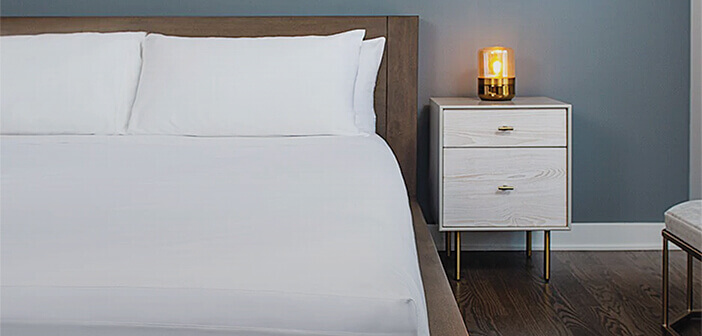
When Ruth Young-Loaeza first began designing what would become Neet Sheets, it wasn’t in a lab or boardroom. It was in her living room, using her own hands and experience from years working as a housekeeper.
“I created a very rustic prototype to solve a personal problem,” said Young-Loaeza, founder/CEO, Neet Sheets. “I was a housekeeper for 23 years. Making beds was part of my job description—it wasn’t optional.”
Born and raised in Mexico City, Young-Loaeza immigrated to the U.S. as a young adult and worked her way up in hospitality. “When you come here, you start from scratch,” she said. “I took the jobs that were available, and housekeeping was one of them. It was hard work, but I learned so much about how hotels really run.”
After a serious car accident left her unable to work for months, she found herself rethinking the toll the job had taken on her body—and how it might be improved.
“When I was recuperating from the accident, I thought, ‘How can I make this better?’” she said. “I experienced all the pain of making beds—the repetitive motion, bending, pulling, tucking. So, I improved my original prototype.”
Neet Sheets is a patented ergonomic bed linen system designed to make bed making faster, easier and safer. The design replaces traditional elastic corners with multidirectional stretch edges and built-in flaps that hold sheets in place without the heavy mattress lifting typical of the job.
“Every hotel housekeeper knows the struggle,” Young-Loaeza said. “You’re lifting heavy mattresses hundreds of times a day. It wears you down.”
Field tests have shown a 47% reduction in bed-making time, a 75% decrease in mattress lifting effort and a 53% productivity boost. “We’ve done this over and over,” she said. “The bed sheet lands perfectly on the first try. There’s no strain—just tucking. That’s it.”
The inventor’s journey from prototype to product began in 2021, when she approached a local hotel to test her design. “I showed a prototype to the housekeeping manager at Casa by the Sea Hotel,” she recalled. “He was blown away. He told me, ‘We want this. Can you fulfill an order?’ I said, ‘Absolutely, yes,’ even though I had nothing.” That first order—worth nearly $40,000—set the company in motion.
Since then, Neet Sheets has been tested in boutique and resort hotels, with a major ergonomic study now underway at The Ohio State University. Early data points to a clear reduction in workplace injuries and time spent on repetitive strain tasks, two of the biggest challenges facing hotel housekeeping departments.
“When I started looking into it, I found that the industry knows bed making is a problem, but innovation has been lacking,” she said. “Now we’re helping hotels reduce injury costs and helping room attendants avoid the pain I went through.”
The product is manufactured in Mexico, a point of pride for Young-Loaeza. “It’s important to me that our sheets are made by skilled workers in Mexico,” she said. “It’s where I’m from, and I want to give back.” The company has also begun exploring U.S.-based production through a major distributor to meet growing demand.
The product’s durability has become one of its selling points. “We’ve tested the sheets in multiple fabrics and blends,” she said. “We have sheets that have been washed more than 300 times in three years, and they still perform perfectly.”
Her innovation and persistence caught national attention when she appeared on “Meet the Drapers,” a televised pitch competition hosted by venture capitalist Timothy Draper and his daughter, Jesse Draper. Neet Sheets took first place, earning a $750,000 investment and mentorship from the Draper family.
“It’s an honor,” she said. “When I did my pitch, Timothy Draper got out of his chair. It was the only time he did that.”
Young-Loaeza was competing against 11 other startups across tech, fintech and agritech sectors, and she represented the entire state of Alabama.
Prior to her TV appearance, Young-Loaeza had participated in Alabama’s G-Beta accelerator program, a statewide initiative supporting high-potential startups. Neet Sheets was one of only two companies selected from a nationwide pool of more than 150 applicants, and she was the only female founder with a physical product. “They gave me a place to live and the resources to develop my business,” she said.
Young-Loaeza said her story resonates with other women and immigrant founders. “People sometimes see housekeeping as low-skill work, but I see it as expertise,” she said. “We know what works in real life. Innovation doesn’t just come from tech labs—it comes from people on the ground who live the problem every day.”
Now based in Alabama, she continues to refine the product and expand its reach in the hotel market. “This is just the beginning,” she said. “Hotels are starting to see that making beds shouldn’t be a health hazard.”
Her mission remains grounded in empathy for the workers who make the hospitality industry possible. “My goal has always been to protect housekeepers,” she said. “I know their pain. I’ve lived it. Neet Sheets is about dignity at work and making sure the people who take care of guests are taken care of, too.”
As the company grows, she sees Neet Sheets not just as a product, but as a movement to improve the hospitality workforce. “We’re not just selling a product,” she said. “We’re changing a daily routine that millions of people do around the world. And we’re making it better.”