

Hotel owners and operators are increasingly rethinking the boundaries of guest value—and it’s no longer just about the room.
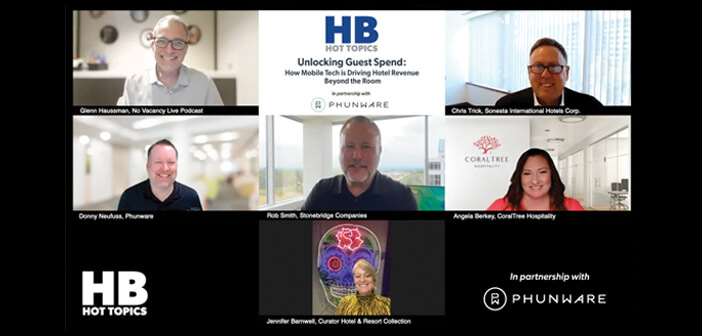
In the latest Hotel Business Hot Topics session “Driving Hotel Revenue Beyond the Room,” in partnership with Phunware, moderated by Glenn Haussman, founder/host, No Vacancy live podcast, hospitality leaders Jennifer Barnwell, president, Curator Hotel & Resort Collection; Angela Berkey, senior director, reservation sales & CRM, CoralTree Hospitality; Donny Neufuss, senior director, business development, Phunware; Rob Smith, CEO/president, Stonebridge Companies; and Chris Trick, chief marketing and performance officer, Sonesta International Hotels Corporation, came together to explore how data, mobile platforms and behavior-based personalization are transforming how hotels engage guests and generate incremental revenue.
“When we talk about revenue, the conversation usually starts and ends with RevPAR,” said Haussman. “But if you only focus on what you’re charging for the room, you’re missing the broader opportunity.”
That broader opportunity, panelists agreed, lies in understanding guest preferences and reaching them where they’re most active: on their mobile devices.
“Your mobile phone is the remote control of your life,” said Trick. “It’s how people engage the online world with the offline world. It’s certainly how our guests engage with us. For our guests, it’s really about convenience and control. It enables that connection with the brands throughout the stages of their journey, and it helps formulate that personal relationship with the guest.”
At Sonesta, that means using data to create personalized experiences that both enhance satisfaction and encourage spending.
“If we know a guest likes a specific spa treatment or prefers red wine, that’s not just trivia—that’s revenue,” he added.
Berkey emphasized that the goal isn’t to replace people with data but to empower teams with it. “We really want to use data to make our agents more successful in their conversations. It’s not about automation for the sake of efficiency. It’s about helping the team connect with guests more meaningfully.”
Behavioral data allows hotel staff to make smarter recommendations—like suggesting an extended stay, an upgraded room or in-room enhancements. “If you know that someone stays with you every year for their anniversary and always goes to the spa, that is something we can reflect back in the conversation,” she said.
Mobile tools are at the heart of this shift, but adoption still has a way to go, said Smith. “We have a very small percentage of people checking in with mobile, but it’s growing. The friction point is ease of use. If it’s not easy to use, people won’t adopt it.”
Stonebridge is working to streamline mobile key and contactless check-in experiences to match the expectations of younger travelers. “The Gen Z crowd and younger millennials want everything on their phones,” he said. “But even older generations are starting to expect that level of convenience.”
Barnwell echoed the need for digital engagement. “There are no more gatekeepers,” she said. “Guests book and research independently, and they expect answers on their own time.”
For hotels, this means shifting from passive to proactive communication. “It’s about pushing relevant content to the guest rather than waiting for them to ask,” Barnwell said.
Phunware’s Neufuss brought a cross-industry perspective, noting how hospitality can borrow from sports and media when it comes to engagement. “We started in verticals like the NFL and CBS Sports, where personalized fan engagement is everything,” he said. “The same rules apply in hospitality.”
Using Phunware’s tools, hotels can send messages tailored to guest behavior and location—like a bar promotion triggered when a guest enters the lobby, or a spa special after they browse related content in the app.
“It’s not just about blasting promotions,” Neufuss said. “It’s about predictive personalization—understanding what the guest wants, before they ask.”
This kind of smart targeting is increasingly important as third-party cookies disappear. “With cookies going away, your app becomes the new cookie,” he said. “Guests opt in to share information, and you use that to deliver value—not just sell something.”
Neufuss shared a real-world example: “One of the ways to get the people to the restaurants has always been the happy hours, but we’ve taken it a step further, where we can geofence outside of the resorts so we can see where your guests are when they’re not on your resort. And if we see that they’re downtown by pubs or cocktail lounges, we can pre-seed a message that, when they step into that area, they get a message at four o’clock that says, ‘By the way, we have a great happy hour back at the resort, and if you come there, first drink’s on us.’”
That approach has proven effective. “Thirty percent of the people who use our app say that one of the things they love about the app is they didn’t know that this stuff existed at the resort,” he added. “They weren’t aware that even these specials were happening or that these restaurants were here.”
Smith echoed the power of geofencing for marketing: “I was just meeting last week with the team, and they told me that they were geofencing demand drivers in the market—for example, wedding venues—so that when folks are going there, all of a sudden they’re going to get an ad for a hotel, knowing that they’re a potential customer in the future.”
A fine balance
Haussman shared a question from a webinar attendee: “How do you balance offers without seeming like you’re nickel and diming? For example, charging for early check-in. People don’t want to spend the extra money, and then they wind up having to wait in a two-hour line when everyone is able to check in.”
Neufuss emphasized that personalization shouldn’t feel pushy. “The messaging isn’t always upsell,” he said. “It’s also just having a conversation; it’s also storytelling. Some of it is making people aware that, ‘Hey, there’s free activities for the kids at the pool happening at two o’clock here.’ Because you know that they have a family. You have another level of opportunity to have a conversation with your guests.”
Still, it’s important not to overdo it. “It can get to a point of saturation that can be a little abrasive,” he added. “And I think for every brand, having a genuine, articulate conversation through digital is a way to build that loyalty and not necessarily trying to sell them something on the spot, but just getting to know them better and build that relationship.”
Smith added that bundling can give guests more control: “Instead of making it a forced resort fee, letting the customer choose: Before you come in advance, you can get parking, breakfast, etc. if you pay x. And we’re finding that they’re opting in on it.”
Accessibility is another area where tech is making a difference. “In our platform, we have the ability where, if you would like to have an accessible route, check the box, and it will only take you in places where wheelchairs can go through,” said Neufuss. “There is the ability to have a voice speak to you and tell you turn-by-turn directions.”
Berkey highlighted how technology can also broaden guest experiences. “We basically can offer both on-property experiences and off-site experiences through a partnership,” she said. “For the guests, they can create their entire itinerary. It’s been extremely successful, especially in southern Utah with a lot of outdoor adventures. We build our brand and build that guest experience.”
Barnwell stressed the importance of piloting new tools and maintaining a human touch.
“I would encourage all our hotel industry people to do your research, pilot test things, beta test things and see what the best fit is for you,” she said. “The absolute worst thing is when the technology doesn’t work. Humans are not going away. There are always going to be humans in our property.”
Haussman added, “Don’t be afraid to try something and fail at it. Just do it quickly and move on.”
Trick reflected on where the industry is headed: “It’s all about understanding our guest; delivering personalized experiences and messages; and enhancing the guest experience.”
Neufuss concluded with a guiding principle. “The customers who are most successful with us are the ones who come to us with the problem, not with the tech,” he said. “Don’t start with the tech. Start with the function. They came to me with, ‘Here’s a problem we have…’ Once we start there, that’s where we can flourish.”
Smith summed it up simply: “We like to use technology to solve for the mundane so that our associates can spend more time enhancing the guest stay, which will help retention and help the guest experience.”
