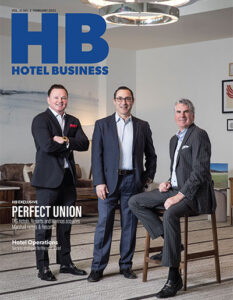
At the height of the pandemic, OLS Hotels & Resorts, an operator of hotels in Hawaii and on the mainland, rebranded to Springboard Hospitality. Ben Rafter, the company’s president/CEO, said at the time the new identity “encapsulates our abilities to uncover opportunities, develop innovative solutions and drive more profit for owners and investors.” Hotel Business caught up with Rafter to discuss Springboard’s recent activity, tourism in Hawaii and how he drew up a new hotel company on a mountain hike.
How did you get into the hotel industry? What attracted you to it?
I was originally a tech person. My first job was at Westin Hotels & Resorts in the technology department. I knew very little about hotels and a lot about emerging technologies and databases. I left to do a startup that was eventually sold to Amazon, worked for 15 more years in technology and then sold another startup. Mike Paulin, a longtime hotelier, called me and asked me if I wanted to hike to Everest Base Camp. I said yes, and while hiking, we mapped out how to do a hotel company that married his larger-than-life hotelier background and my tech background. The resulting company, Aqua Hotels & Resorts, eventually grew to 50 properties in Hawaii and is now part of Marriott Vacations.
The hotel industry is a great industry. The people are great, it’s full of new ideas and it’s fantastic to see guests respond to an experience or a team member’s efforts. I can’t imagine going back to technology at this point. It’s more fun to work on new technologies within this industry that help make it better.
Springboard Hospitality has nearly doubled in size over the past 24 months. How were you able to accomplish that?
I hope it’s because we have a good reputation for working with owners. When the pandemic hit, we were one of the first to start trying new ideas and making moves.
We’ve seen a lot of independent properties enter our fold. There aren’t many great independent operators out there anymore. Running independents is very difficult. It takes fully customized and localized experiences, while services, marketing programs and revenue management are different…just to name a few. For owners who have independent hotels and experiences, hopefully they see that we’re structured to help them.
The Springboard portfolio consists mostly of independent hotels. Why is that and will that be the case moving forward?
Springboard believes in specialization. We localize and customize experiences for our guests, which is a hallmark of independent hotels. A suburban Hilton Garden Inn is a fine hotel with a defined audience, and there are plenty of good choices to operate it. We could operate it, but it’s not what we specialize in. Running an independent hotel requires the ability to go out there and create revenue.
All that said, we think there’s a nice confluence with soft brands. The idea of an independent hotel with the engine of a major brand behind it is appealing. Thus, while our roots will always be in independent [hotels], I see us working more and more with brands.
Whether soft-flagged or purely independent, it’s worth noting that customers are gravitating more towards experiences and uniqueness. “Bleisure” (business and leisure) isn’t going away anytime soon, and the ability to drive customized marketing programs and experiences is going to be critical.
Can you tell our readers about the new hotels that Springboard has brought to the fold? Is there anything in the pipeline?
We’re working with a lot of owners that are reinventing hotels in leisure, destination markets. Mammoth Mountain, CA; Lake Tahoe; and Jackson Hole, WY, come to mind as new markets. We’ve added a lot of independent hotels in drive-to markets that are near urban cores. This would include Carmel, Sedona and Sonoma [in California]. We have two new builds in Los Angeles and a transformation in Anchorage, AK. Likewise, we’re expanding in Hawaii again where we’ve added more than 1,000 rooms and have more than 1,000 more in the pipeline. On the West Coast, I’d like to see a shift whereby we keep filling out urban gateway markets. In the East, we’re continuing to expand in leisure markets where we have added product in Florida, among other places. It’s exciting to see the number of owners out there with new ideas.
Your company has 10 hotels and an office in Hawaii. How did tourism on the islands progress through the pandemic?
Not surprisingly, tourism was difficult during the early stages of the pandemic. Hawaii and Alaska are unique to the U.S. in that they control their entry points. One can’t just drive to Hawaii à la driving between California and Arizona. There was no way to get to Hawaii without subjecting oneself to quarantine, thus Hawaii had the biggest decline of any major tourism market in the U.S. Worse than New York City, Los Angeles, San Francisco and all the other markets we hear about. As testing became prevalent, though, there became ways to get to Hawaii, albeit between fear of airplanes and the hassle of testing, times were still very difficult.
We’re in a tale of two Hawaii markets. The neighboring islands such as Maui are benefiting from the relative safety and pent-up demand for tropical and exotic travel. Oahu, inclusive of Waikiki, depends on Japan and other international markets and, thus, is struggling.
I’m a believer that Hawaii itself needs to go through a reinvention. The beach is part of any Hawaii vacation, but selling mass tourism around sun and sand is probably not what Hawaii’s future guests want, nor is it what the residents of Hawaii want. We’re trying to reinvent it to feature sun and sand, but also showcase the diversity of Hawaii—the food, culture, experience and people.
What are some emerging trends you see this year for the industry?
Everyone is focused on pandemic safety which is important, but our clients and team members assume it at this point. The proper level of safety is akin to having hot water and electricity. It’s the same with ease-of-use features such as mobile key and in-stay communication vehicles. They are all great, but I don’t think they are making or breaking people’s stays with us.
Rather, we’re doubling down on making the stays unique to the location of the hotel. As we came out of the pandemic, the drive-to markets did great because people could get outside and explore in national parks and other areas. We want to be able to sell that “get out and explore” in all of our markets, even if it’s exploring a neighborhood in West Hollywood. Our hotels are unique to each location, and we want to make them even more so.
What’s your prediction for the recovery of the industry?
Logic says things will revert back to the norm, which means big cities like New York and San Francisco will stage a comeback sooner rather than later. Leisure travelers will want to go to urban centers again and business travel will return. While most drive-to markets won’t sustain their current numbers, some of them such as Sedona are now “on the map” and will retain popularity. The pandemic allowed Americans to get out and explore, and some of that freedom will replace the traditional, annual sun and sand vacation. Hopefully taking more leisure time sticks as people combine business and leisure trips or just realize that getting away every once in a while is healthy.
Where do you see Springboard in five years? 10 years?
Springboard’s goal is to be the best independent hotel operator in North America. In the short term, this means filling in the major gateway and drive-to markets in the West, while continuing to build our presence in Florida. Our goal isn’t to grow to hundreds of hotels, though. It’s antithetical to the highly curated experiences that we think make independent properties and soft flags unique.