

For most hotel guests, laundry is invisible. Sheets are crisp, towels are fluffy and uniforms are clean. Behind the scenes, however, laundry operations represent one of the most resource-intensive functions in hospitality, consuming vast amounts of water, energy and chemicals every single day. As the hospitality industry places more emphasis on environmental, social and governance (ESG) goals, laundry has become a critical area of focus.
“Laundry is often the largest consumer of water and energy in a hotel,” said Jeff Lebedin, chairman/managing member, AquaRecycle, a company which specializes in laundry water recycling. “For years, people said you couldn’t recycle laundry water because of chemicals or bacteria.”
A typical hotel generates multiple pounds of laundry each night, from bed linens to towels, banquet napkins to kitchen uniforms. Large resorts and convention hotels may launder tens of thousands of pounds of fabric daily. That scale translates into steep utility bills and a substantial environmental footprint.
“Hotels don’t have many areas where they can cut expenses,” Lebedin said. “But if they can cut utility costs by 20% or 30%, it’s a huge benefit. Laundry is one of the places where that’s possible.”
The environmental stakes are also rising. In water-stressed regions like the Southwest U.S., Mexico and the Caribbean, hotel operations are under growing pressure to conserve water. At the same time, corporate clients and event planners are increasingly asking hotels to demonstrate sustainable practices.
“Some event planners will actually tour a property to make sure they’re saving water and energy,” he said. “Hotels want to show they’re reducing waste, recycling water and cutting energy. It matters to owners, guests and asset managers.”
Lebedin has been working in the space for three decades. When AquaRecycle was founded in the mid-1990s, skepticism was the norm. “Thirty years ago, every expert told me you couldn’t recycle laundry water,” he recalled. “They said it was impossible. They were wrong.”
Since then, AquaRecycle has installed nearly 500 systems worldwide, collectively recycling more than 15 billion gallons of water. That success, he said, came not only from refining the technology but from demonstrating that water reuse could be both environmentally and financially sound.
“A sustainability project with a two-year payback or better is almost unheard of,” he said. “That’s why this has worked—it saves water, it saves energy and it pays for itself quickly.”
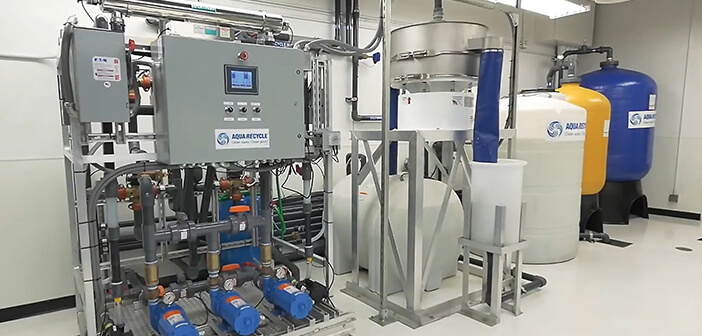
The process of water recycling is less complicated than it may sound. Wastewater leaving the washers is diverted into a treatment system rather than sent directly to the sewer. Solids are filtered out; chemicals and organics removed; and the water is disinfected using UV and ozone. From there, it’s stored and piped back into the washers for the next cycle.
“The process is actually simple,” Lebedin said. “Instead of heating cold city water from 55 or 60 degrees, the recycled water is already around 120 degrees. That cuts energy demand in half.”
Because the recycled water retains heat, hotels not only save on water usage, but also significantly reduce the fuel or electricity required for heating. Typical systems achieve 70%–80% water reuse and around 50% energy savings.
For hotel owners and operators, the case for laundry recycling often starts with the bottom line. Utility costs are rising, and in some cities, sewer surcharges make wastewater disposal expensive. A recycling system reduces both.
“It always comes down to dollars and cents,” Lebedin said. “Yes, sustainability is important. But what makes it work is that it saves money.”
Lebedin added that the technology often complements other laundry solutions, such as tunnel washers, which large-scale laundries rely on. While they can reduce water usage through design, on-premise laundries in hotels frequently benefit more from a recycling system.
While the main drivers are cost and conservation, water recycling can have secondary benefits. Overuse of harsh chemicals can shorten linen life, leading to increased replacement costs and textile waste. Properly balanced water treatment and reduced chemical demand help extend linen durability.
Sustainability can also serve as a marketing and brand value point. “It’s easy to talk the talk about sustainability,” he said. “But it’s even better when a hotel can show it in action. Reusing laundry water is something tangible.”
Lebedin sees the future of hotel laundry sustainability as a blend of proven recycling technologies and emerging data-driven tools.
AquaRecycle recently introduced monitoring systems that allow hotels to track water use across their operations. “Owners and asset managers want transparency,” he noted. “They want to see the numbers.”
