

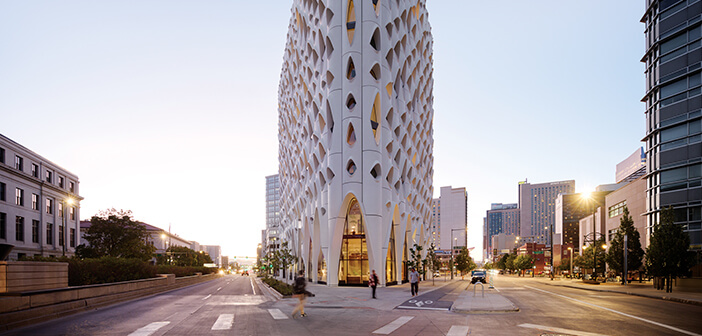
When guests walk into a Populus Hotel, the story of sustainability is impossible to miss. From exposed concrete that reduces the building’s carbon footprint to biophilic design that draws inspiration from nature, every detail reflects a commitment to leaving the planet better than it was found.
For Urban Villages, the development company behind the brand, Populus Hotels is more than a place to stay—it’s a chance to redefine what urban hospitality can be when environmental stewardship meets design and guest experience.
Jon Buerge, CEO, Urban Villages, described the origins of the company and its hotel collection as deeply rooted in a respect for nature. “We all grew up in rural areas where our lives were integrated with nature in a very seamless way,” he said. “For me, I was born and raised in Aspen, CO, and spent most of my childhood wandering in the woods. As I launched my career, I initially studied environmental law, planning to work on international environmental regulations.”
Urban Villages has a broad portfolio that includes multifamily housing, student housing, office and mixed-use urban development projects. Sustainability has always been a central focus. “We know that we can’t afford to do every single bell and whistle when it comes to building a green building, so we focus on where we can make the biggest impact in a way that brings the customer into that experience,” Buerge said.
The move into hospitality was driven by the potential to reach more people and provide meaningful experiences. “In the hotel industry, you serve so many more people than in an apartment building or office,” he said. “There’s also ample opportunities to inspire, whether it’s the way you integrate design or how you integrate a story into the guest experience.”
Buerge saw a gap in the urban hotel market for environmentally forward-thinking brands.
“We met with most of the established brands, asking how they think about environmental stewardship,” he said. “What we found was very little beyond basic recycling and limited housekeeping adjustments. We saw a real opportunity to create something that doesn’t exist in an urban environment.”
Populus Hotels embraces biophilic design, which draws inspiration from natural forms and ecosystems to inform both aesthetics and sustainability. “We started thinking about how we can make it an experience that people get goosebumps around,” he said. “That led us to biophilia, looking to nature to create a building that tells the story visually without having to preach when you come through the door.”
The design of Populus Hotels owes much to the collaboration with architecture firm Studio Gang. “We ultimately landed in founder Jeanne Gang’s office, and her approach immediately resonated with us,” Buerge said. “She studies ecosystems and natural forms, and her biophilic design philosophy aligned perfectly with our vision.”
Studio Gang helped translate the company’s goals into the physical environment, creating spaces that are visually striking while embedding sustainability elements into every detail.
The company’s first major urban hotel, Populus Denver, incorporated innovative materials to reduce its carbon footprint. “We ended up really getting excited about a fly-ash-alternative concrete product,” said Buerge. “We estimated it would reduce our carbon footprint by about 30%—not just the concrete, but the entire building.”
He described how this choice set a precedent for sustainable construction: “We built the building out of it, and we decided to leave our core all exposed so people could see it,” he said. “It’s the first commercial building in the U.S. to use it, and it didn’t cost any more than traditional construction.”
Populus Seattle, which opened in May, took the concept further through adaptive reuse of historic buildings. “We often say the greenest building is the one you don’t build,” said Buerge. “If there’s an existing building you can give new life to, that’s the most environmentally friendly thing you can do.”
The brand also invests in carbon offsets. “We landed on carbon as the most accurate way of tracking impact,” said Buerge. “In Denver, our total carbon footprint was around 6,000 tons. We acquired 7,000 tons of U.S. certified carbon credits, about 85% sourced in Colorado, to more than balance our carbon budget.”
Affordability and accessibility are also part of Populus’ mission. Buerge explained, “We don’t want environmental stewardship to be just an elite thing. We want it available at any price point. By offering smaller-efficiency rooms, we’re able to be price competitive while maintaining a high-design, energy-efficient hotel experience.”
Urban Villages partners with Aparium Hotel Group for hotel management, ensuring operations align with the brand’s environmental objectives.
“Our goal is that each new hotel is several steps ahead of the first ones,” said Buerge. “The guests experience a hotel that’s different from other options, creating loyalty and hopefully inspiring other developers to follow suit.”
