

With tighter margins and increasingly high guest expectations, hotels are constantly seeking strategies to boost operational efficiency, cut costs and improve the guest experience.
The latest Hotel Business Hot Topics session, “Optimize and Automate Your Procurement to Fuel ROI,” in partnership with Entegra, explored how hotels are navigating cost pressures, supply chain volatility and rising guest expectations, while also looking ahead to the role of AI, sustainability and group purchasing organization (GPO) partnerships in shaping the industry.
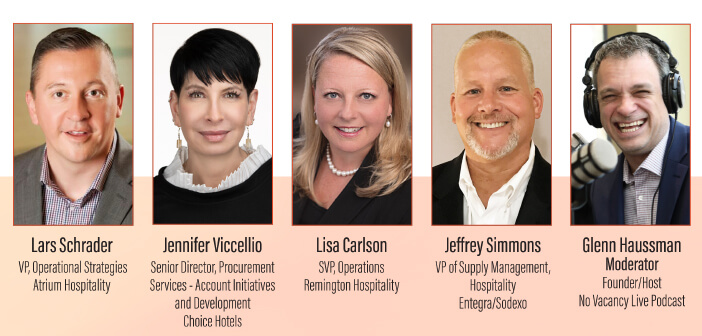
Moderated by Glenn Haussman, founder/host, No Vacancy Live podcast, the panel featured Lisa Carlson, SVP, operations, Remington Hospitality; Lars Schrader, VP, operational strategies, Atrium Hospitality; Jeffrey Simmons, VP, supply management, hospitality, Entegra/Sodexo; and Jennifer Viccellio, senior director, procurement services – account initiatives and development, Choice Hotels.
The session opened with a discussion on the economic pressures impacting the hospitality sector. Carlson noted that hotels are feeling a dual challenge: rising operational costs alongside guest expectations for higher-quality experiences.
“We’ve seen a lot of ADR erosion, which has really been difficult in terms of trying to produce financial performance,” she said. “Expense reductions and managing expenses has become even more the focus, and that’s been a real challenge for the industry.”
Haussman acknowledged that occupancy and demand trends, although stabilizing in some markets, have added another layer of complexity to hotel operations.
Schrader emphasized that a reactive approach is no longer sufficient. “It’s really about building resilience into everything that we’re doing, especially when it comes to cost management and planning,” he said. “Hotels need to think strategically about procurement and operational efficiency while maintaining guest satisfaction.”
The panel agreed that today’s hotel leaders must find the balance between cost control and delivering an exceptional guest experience—a theme that ran throughout the session.
Strategic pillar
Viccellio explained that Choice helps franchisees optimize procurement by addressing the challenges of meeting diverse hotel needs while upholding brand standards.
“We help to develop a procurement strategy so that we can buffer against some of the challenges that our hotels are seeing,” she said, noting that this approach also involves forecasting potential supply chain disruptions and leveraging data analytics to uncover opportunities for operational efficiencies and cost savings.
Carlson and Schrader reinforced that procurement cannot be viewed solely as a back-office function, with the latter noting, “Margins continue to tighten, expectations are growing from guests as well as stakeholders. It’s not just about cutting costs but being intelligent and strategic about how we use our funds from a procurement perspective—and doing so without compromising the overall guest experience.”
Each panelist underscored the importance of using GPOs as partners rather than just a source of lower prices. Simmons said, “Choice is a fantastic customer for us—it’s more like a partnership.”
GPOs in action
The discussion highlighted several examples of GPO collaboration driving measurable impact. Schrader pointed to Atrium’s high participation rate with its GPO, which contributed to the company being ranked the top hotel brand in the U.S. for guest service, according to J.D. Power’s guest satisfaction benchmark.
“We put our efforts in, and we get the efforts out from our GPO, which helps with pricing, but really with the quality product that our guests are looking for,” he said.
Proactive engagement with GPOs can avoid unexpected costs, noted Carlson. She cited a recent linen order for a new hotel opening where timely coordination with a GPO avoided $7,000 in tariffs.
“It’s incredibly helpful to have those insights,” she said. “We have almost weekly strategic conversations with our partners, helping us stay ahead of market trends, price fluctuations and supply chain challenges.”
Viccellio pointed to a recent success story with Entegra during the period when her company rolled out Choice Data, a program and brand standard across its hotels. In this instance, an additional or ancillary service was required—not something hotels needed daily.
She explained how leveraging the relationship with the company’s account manager helped solve the problem efficiently. “I said to the account manager, ‘This is kind of a problem that we’re solving for. What do you see across the industry?’ It just so happened that they had another partner within their organization that provided the service that we were looking for,” she said. The existing collaboration made it convenient to access solutions that might not have been top of mind previously but were crucial to current brand needs.
Simmons explained that GPOs can also support areas beyond traditional procurement. “It’s not just culinary items,” he said. “A GPO can help with elevator contracts, parking services and other operational needs. They act as an extension of the hotel’s team, helping improve service consistency while delivering cost savings.”
Collaboration with GPOs must be strategic and comprehensive to achieve meaningful results. Simmons noted that participation and commitment are key. “If you’re going to sign up and then pick only a few products or programs, you’re not going to see the full impact of what a GPO can truly bring,” he said.
Data is key
The discussion turned to the role of data and analytics in guiding procurement decisions. Data helps minimize waste, improve supplier management and streamline internal processes.
“We’re still in the early stages of understanding how to take data and apply it broadly,” said Schrader. “It’s not just about lowering prices; it’s about smarter sourcing and operational efficiency.”
Choice’s Viccellio noted that predictive insights can help hotels anticipate fluctuations in food, beverage and other supply categories. “You leverage data and analytics and tie some of these KPIs to it. That will help eliminate labor costs and waste, while increasing energy efficiency,” she said.
Carlson added that historical data combined with predictive insights allows for better budgeting, forecasting and planning.
The panelists also addressed the emerging role of artificial intelligence (AI) and automation in hotel operations, with Simmons describing applications ranging from predictive analytics to robotic housekeeping and guest interactions.
“AI is meant to supplement staff rather than replace them, helping teams operate more efficiently and deliver better guest service,” he said.
Schrader noted that HR processes, including recruitment and onboarding, are benefiting from AI, which can aid in enhancing associate experiences and supporting talent acquisition.
Technology should focus on freeing staff to engage more directly with guests. “Use technology to do the things that are back office or not guest-facing, so team members have more time to interact with our guests,” said Carlson. “Leaders can spend more time training and developing their teams and planning strategically.”
Haussman added that innovation in operations is not just about efficiency, but also about adapting to market changes. “When we feel like we’ve hit a wall in opportunity or profitability, something changes that resets everything,” he said. “AI and technology are part of that reset, allowing hotels to maintain service levels even with labor constraints.”
Sustainability emerged as another theme, though panelists noted it is still an evolving consideration in high-impact areas like bedding and entertainment systems.
Schrader and Carlson emphasized the guestroom bed as a critical component of experience. Simmons highlighted emerging mattress recycling programs and new materials such as bamboo or lightweight bedding, which reduce environmental impact.
Sustainability efforts are currently more focused on consumables, like bulk amenities and reducing plastic use, but innovation in furniture, linens and electronics is expected to grow, according to Carlson. “We’re trying to balance guest experience with sustainability,” she said. “It’s not just about cost—it’s about long-term value and operational impact.”
The conversation turned to strategies for 2026 and beyond, with an emphasis on technology, forecasting and strategic procurement.
Carlson stressed the importance of looking ahead rather than relying on historical trends. “Spend less time in the rearview mirror and more time forecasting, planning and purchasing at the right time,” she said.
Simmons added that predictive analytics, AI and business process outsourcing will continue to streamline operations.
