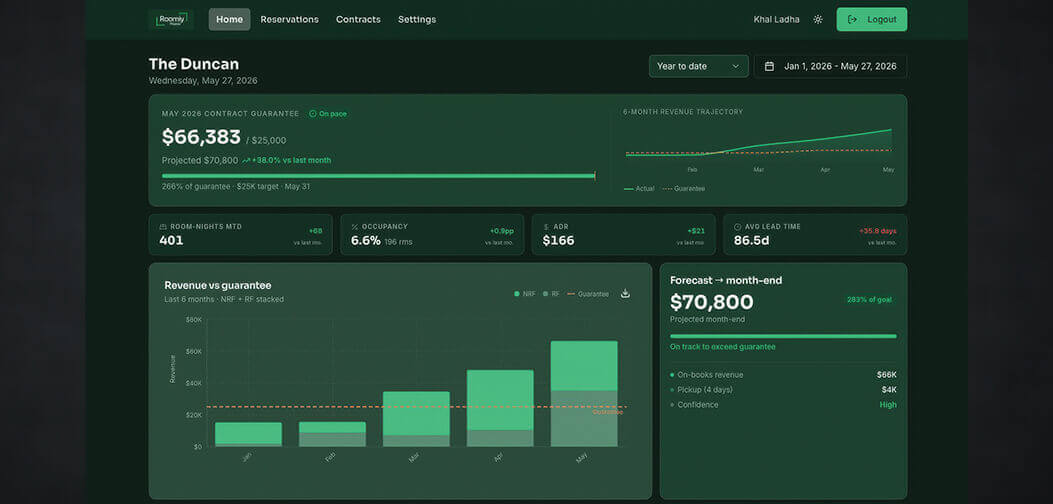
As hotel booking windows continue to shrink and operating costs remain elevated, some hotel owners are shifting their focus away from forecasting and toward a different goal: cash-flow certainty.
According to Khalid Ladha, cofounder/CEO, Roomiy, the challenge facing many owners today is not simply predicting demand but managing the growing volatility surrounding it.
“We’re seeing booking windows shorten,” he said. “For many hotels, almost a third of bookings happen three days in. There is a huge compression in booking windows, which has made forecasting and cash-flow consistency very hard to rely on.”
The trend has become particularly problematic for hotel owners, whose assets depend on stable income streams. While operators naturally seek to maximize room rates, Ladha noted that hotels are ultimately real estate assets that perform best when volatility is minimized, adding, “Cash- flow certainty becomes super-important.”
While much of the hospitality technology sector has focused on improving forecasting tools, Ladha argued that forecasts themselves are becoming less valuable as booking behavior becomes increasingly unpredictable.
“I think there is little to no value in accurate forecasting,” he said. “What is the value of a forecast? It’s a theoretical thing. What actually happens is what we have to optimize for.”
Instead, he believes hotel owners are seeking technologies that deliver measurable business outcomes rather than additional dashboards or reporting tools. “What people are asking for is results,” he said.
Roomiy’s flagship offering, which the company describes as “NOI as a Service,” is designed to help owners increase net operating income while reducing distribution costs.
The model replaces traditional commission structures with a flat annual fee, allowing hotels to sell rooms through the platform without commissions or credit card processing fees.
Ladha said the goal is not to compete with hotel brands but to provide an alternative to higher-cost distribution channels.
“If we can help a hotel lower its OTA mix, that’s valuable,” he said. “If we can help improve cash-flow certainty, that’s helpful. If we can lower credit card fees, that’s helpful, too.”
The company is also working to accelerate onboarding. Rather than lengthy implementation cycles, Ladha envisions a future in which hotels can quickly upload booking data, receive an offer and begin generating predictable revenue streams within days.
Like many hospitality technology providers, Roomiy sees AI playing an increasingly important role in helping owners make financial decisions.
Ladha believes AI’s greatest impact will come not from replacing hospitality but from streamlining operational workflows and improving access to data-driven insights.
“The future is probably AI generative,” he said. “You’re going to talk to your data and your data lake. You’ll have fintech-embedded solutions inside those flows.”
Rather than requiring operators to analyze reports manually, he envisions owners asking AI-driven systems strategic questions directly, such as ‘I have a refinance coming up in 24 months. I need to boost my net operating income. What strategy would you give me over the next six months?’”
Data quality remains critical to that vision. Because Roomiy works directly with ownership groups, Ladha said the company can access detailed booking and channel information across an entire property rather than seeing only a single distribution source.
That level of visibility has also enabled the company to deploy AI-powered tools internally, including an AI account manager that automatically generates reports and summaries.
“There are small things where we can do more with less as a small company,” he said.
Ladha believes the need for greater financial predictability is particularly acute among owners of 3- to 4.5-star properties, especially independent hotels and franchisees facing rising costs and deferred property improvement plans (PIPs).
Many owners, he said, are caught between needing renovations to remain competitive and lacking the cash flow necessary to fund them.
Roomiy sees an opportunity to help bridge that gap by providing additional revenue streams that can support capital projects.
“You could use the revenue from Roomiy to fund your PIP and create a healthier branded asset that drives more revenue,” he said.
Despite the growing focus on AI and automation, the Roomiy CEO stressed that technology should support rather than replace the hospitality experience.
“We have to remember to keep hospitality first,” he said. “It’s important how people feel. That’s what they remember at the end of the day.”
Ladha expects AI’s influence on hospitality to be as transformative as the internet itself, though he believes the industry is only beginning to understand what that future will look like.
“We can’t fathom what role it will play,” he said. “It’s the first inning.”