


When Friends debuted on television in 1994, few could have predicted that a fictional coffeehouse would become one of the most recognizable gathering spots in pop culture. Yet, for a generation that grew up quoting Chandler and debating Ross and Rachel, Central Perk was more than a backdrop. It was the living room before streaming had living rooms.
Now, through the efforts of Colicchio Consulting and its partners at CenPer Holdings LLC, Central Perk has stepped off the soundstage and into the real world. The concept has already found success in Boston and recently debuted in New York’s Times Square, adjacent to The Times Square EDITION, and the company hopes to expand the brand to more hotels across the world.
The origin story feels almost like a lost episode of the show. Phil Colicchio said he was initially approached by a Los Angeles-based colleague with an idea centered not on Central Perk itself, but on Joey Tribbiani, the food-loving Friend. The pitch imagined Joey—inspired by fellow New Yorker Tom Colicchio—as a failed actor who discovered his true calling in food and opened a sandwich shop that honored his love of subs. The thinking was that Warner Bros., owners of the Friends properties, might respond to a character-driven concept.
Timing proved critical. At the time, Tom Colicchio—best known as the longtime head judge of Top Chef—was operating ’Wichcraft, a sandwich-focused brand with several leases in place that wasn’t living up to its potential. Phil Colicchio saw an opportunity.
He recalled calling his cousin and suggesting that, if the idea gained traction and moved quickly, those leases might be repositioned. Tom was intrigued.
A meeting was secured with the Global Themed Entertainment and Licensing division of Warner Bros., and the Joey’s sandwich concept was pitched, grounded in what Phil described as an overarching commitment to hospitality and quality.
The studio’s response reframed everything. Warner Bros. asked them to return the next day and suggested that, while the Joey idea had merit, it had been searching for a hospitality-driven group to take Central Perk itself to market. Would they be interested?
As Phil Colicchio put it, it was the proverbial dog catching the car.
Building a prototype
What followed was far from a straight path. There was no existing prototype for a Warner Bros. food and beverage concept.
Raising capital for an experiential café anchored in a television property proved more difficult than anticipated. Then, the pandemic intervened, slowing momentum and forcing the group to reassess its strategy.
The delay offered an unexpected advantage. It allowed the CenPer Holdings team to study the market carefully and to consider how a physical café could integrate online engagement and merchandising. Over roughly two years, they raised capital, assembled partners and refined a concept that would not simply replicate a television set.

The first Central Perk opened in Boston to strong reception. Its design intentionally avoided becoming a museum piece. Instead, Phil Colicchio said, the goal was to bring forward the icons of the set—the orange couch, the warmth, the intimacy—while asking a contemporary question: If this group of friends were living their lives today, what would their hangout look and feel like?
Times Square moment
Located at the corner of 47th Street and Seventh Avenue, Central Perk sits alongside The Times Square EDITION, positioning it within one of the city’s highest-profile hospitality corridors. The Colicchio Consulting partners led the strategy for CenPer Holdings by presenting and assembling the deal structure, working closely with the building ownership’s representatives, the hotels and Warner Bros./Discovery to craft a unique occupancy arrangement.
The café features the Orange Couch Room, inspired by the show’s set and previously introduced in Boston. And, yes, the Times Square outpost leans into the soundtrack of the era, reinforcing the sense that, at least for the length of a latte, it might still be 1998.
Guests can order six original coffee blends in multiple preparations, alongside specialty sandwiches including one created by Tom Colicchio—The Tribbiani.
The chef described the Tribbiani as a classic Italian sub, rooted in the kind of flavors found in New York and northern New Jersey delis. A defining element, he said, is the sharp red wine vinegar that provides its characteristic bite. The goal was not to overcomplicate it, but to honor the region and the character who inspired it.
Quality, he stressed, could not be compromised simply because the café sits in Times Square.
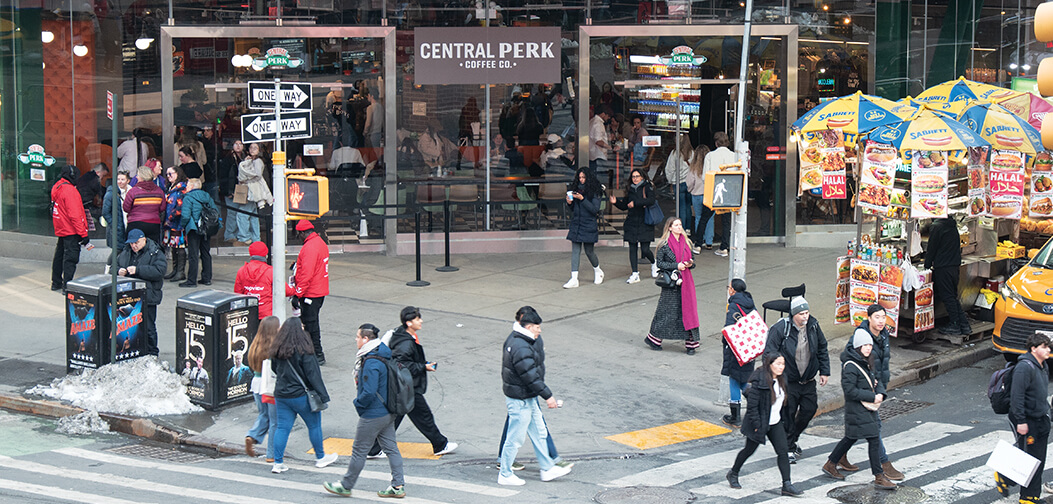
“A brand is built around quality,” he said, noting that standards should not shift based on location. In fact, he argued the opposite. Times Square, with its density and global foot traffic, demands more. “You’re going to see more people here than anywhere else,” he said, comparing it to his experience operating in Las Vegas, where volume requires unwavering consistency. Cutting corners in such visible markets is not an option.
That philosophy also distinguishes Central Perk from many themed venues that rely on nostalgia. Without quality food and coffee, guests might stop in once for a photo and choose somewhere else next time. The theme opens the door. The product has to bring people back.
More than nostalgia
Trip Schneck views Central Perk as more than a novelty. He believes the concept aligns naturally with hotel environments. Its universal, multigenerational appeal makes it attractive to properties seeking lifestyle-driven spaces with built-in storytelling. Unlike a traditional lobby coffee bar that winds down after breakfast, Central Perk is designed as an all-day café.
Morning and afternoon coffee service transitions into evening programming, including an alcoholic beverage menu anchored by espresso martinis. That three-day-part model, he said, materially changes the profit-and-loss equation and extends the activation window of valuable lobby or retail square footage.
He pointed to examples of high-performing hotel coffee concepts to illustrate the embedded coffee culture in hospitality. Central Perk, he said, builds on that foundation with entertainment value and brand recognition that few standalone cafés can match.
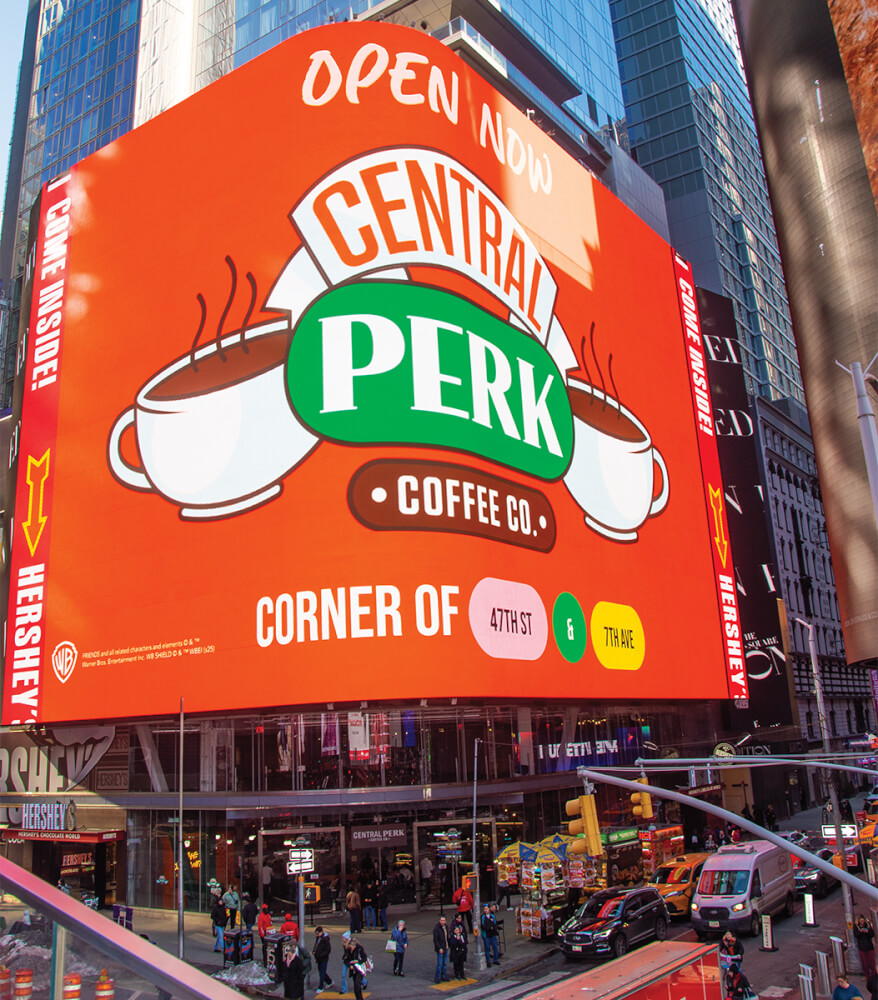
Phil Colicchio agreed that the ethos aligns cleanly with hospitality goals. Hotels aim to create welcoming environments where guests linger, connect and feel at home. Central Perk, though fictional, has always symbolized that.
Central Perk represents both an extension and a departure from Colicchio Consulting portfolio. It is deeply rooted in popular culture yet structured as a scalable hospitality platform. The team expects growth over the next 12 to 24 months, particularly within hotel settings.
For fans of Friends, however, the appeal remains simpler: It is the chance to sit on an orange couch, sip coffee in a space inspired by one of television’s most beloved hangouts and perhaps hear a familiar ’90s anthem drifting through the speakers.
