

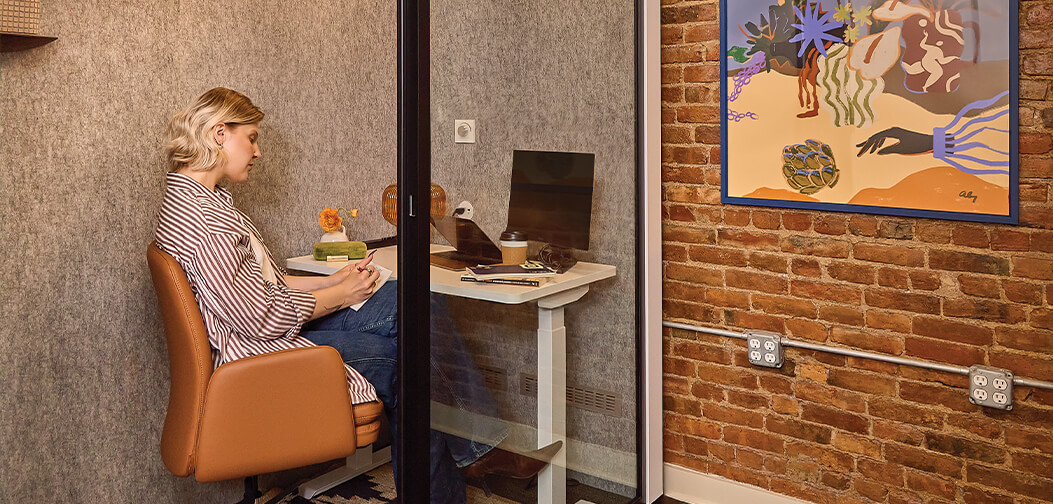
As remote and hybrid work reshapes how people travel and use hotels, a new type of amenity is emerging: reservable private workspaces that function more like a temporary office than a traditional business center.
That is the premise behind Alcove, a startup founded by Helen Knight that installs premium private work pods inside hotels and other locations. The company operates the pods itself and shares revenue with hotel partners, creating what Knight describes as both a guest amenity and a new revenue stream.
“People need more accessible, quiet focus space that they can reliably reserve,” said Knight, who serves as CEO of Alcove. “They need to know in advance that when they’re traveling for work, or even just out around the city, there’s somewhere they can book and close the door and have privacy.”
She said the idea grew out of her own experience traveling for consulting work. Even when staying at hotels, she often struggled to find a professional space to take confidential calls or other tasks.
“I personally would also need space to work, whether it was because we hadn’t checked in yet, or we had checked out but our flight wasn’t until 4 p.m.,” she said. “All of our calls would be confidential client calls, so there really wasn’t an option to just hunker down in a coffee shop.”
That experience led Knight to develop Alcove’s core concept: reservable, sound-controlled pods designed for professional work. Each unit measures roughly 4 ft. by 7 ft. and includes ergonomic seating, a secondary monitor, WiFi connectivity and adjustable lighting.
“They’re larger than a typical phone booth, and are designed to be somewhere you could actually spend eight hours if you needed to,” she said.
The interiors are also customized for each hotel partner. Alcove works with a property’s marketing team to design the decor and artwork so the pod visually aligns with the hotel’s brand.
Rather than selling the pods to hotels, Alcove installs and operates them through a licensing model. Hotels provide space for the units, while the company handles installation, maintenance, reservations and customer service.
“They license the space to us,” Knight said. “We handle everything else and then pay out the revenue share.”
The model also introduces new visitors to the property. Knight noted that at current locations, more than half of Alcove users are not hotel guests, bringing additional foot traffic to on-site outlets such as cafés and restaurants.
While distractions and lack of privacy are common complaints in coworking environments, Knight said the pods address both issues by providing a private, controlled environment that can be reserved on demand. “It’s really just your safe space, your sanctuary to do whatever it is that you need to do uninterrupted,” she said.
Users often reserve the pods for extended work sessions rather than quick calls. The company reports an average booking of about 3.5 hours.
“We often have people staying the full day,” Knight said. “They’ll pop out to grab coffee or lunch, come back and keep working.”
Because the pods function like furniture rather than permanent construction, hotels have flexibility in where they install them. Locations vary widely depending on the property, from lobby work areas and meeting spaces to retail areas or unused rooms. Each unit requires only a standard three-prong electrical outlet and minimal power consumption. “You literally plug it into the wall,” Knight said.
The pods also include ventilation systems that replace the air inside every 60 seconds to prevent overheating during long sessions.
Since opening its first location in Brooklyn in 2024, Alcove has expanded to multiple hotel properties across New York, the San Francisco Bay Area and Seattle, including partnerships with brands such as Hilton and other major operators.
Knight said the company is now focused on further U.S. expansion. “We have a wait list of partners that have been referred to us from our existing hotel partners,” she said. “The better the network is, the better it is for our end users as well.”
Future expansion targets include major markets such as Los Angeles, Washington, DC, Chicago and Boston.
