

When Colicchio Consulting was selected to partner with and advise with the JW Marriott Las Vegas Resort & Spa and Rampart Casino in Summerlin, NV, the assignment was comprehensive. Ownership was in the midst of a $75-million, multi-year renovation marking the property’s 25th anniversary and wanted a new culinary vision that could match the refreshed physical plant.
There was urgency behind the decision. As Phil Colicchio explained, the ownership group understood the competitive landscape in Summerlin. “They knew they had nothing but strong competition out there,” he said. “And they also knew they had a population in Summerlin that was going out at night, and they weren’t going to their place. How do we get them?”
One of the most visible opportunities was a long promenade connecting the resort’s two towers. Though centrally located, it lacked energy and purpose.
“The project was a challenge,” Colicchio said. The 20-year-old facility had strong casino and conference business, but there was “fatigue with concepts that currently existed.” The promenade, he added, was “a bit of a ghost town.”
Rather than treat it simply as a corridor, Colicchio Consulting reconceived it as a streetscape. “Our vision for that promenade was to pop out little vendors right along the hallway and give it a street feel,” he said. Food, beverage and entertainment would work together to make the space “pop” and come alive.
That strategy evolved into the Neighborhood Food Walk, a collection of first-to-market, chef-driven concepts designed to bring both Los Angeles and New York energy to Summerlin.
Trip Schneck described the broader engagement as “a little bit more involved,” noting that the team was tasked with replacing a sleepy Italian restaurant concept with energy and fun, while also creating what ownership described as a restaurant emporium to increase dwell time in the casino and energize the lobby bar program.
The Italian replacement became ai Pazzi, the Las Vegas debut of Chef Fabio Viviani. The concept blends handmade pastas and seafood with playful tableside preparations, reinforcing the property’s upscale positioning.
But the consulting firm’s sourcing extended well beyond a single anchor restaurant. Recognizing the property’s significant Asian and Hawaiian customer base, Colicchio explained that authenticity would be critical.
“What’s going to be great from an Asian perspective that they don’t have out here?” he said of the firm’s early discussions. The answer was Nom Wah Tea Parlor, the landmark New York Chinatown institution founded in 1920 and led by Wilson Tang. Securing Nom Wah for its Las Vegas debut required outreach to New York, but Colicchio framed it as essential to delivering credibility rather than approximation.
At the same time, board members reminded the team that a large portion of the resort’s guests travel from Southern California. To address that constituency, the firm sourced Tacos 1986 and For the Win, both chef-driven brands with strong followings.
Colicchio described extensive tasting research in L.A. before narrowing the field. The goal, he said, was to ensure each concept could stand on its own while contributing to a cohesive, culturally relevant mix.
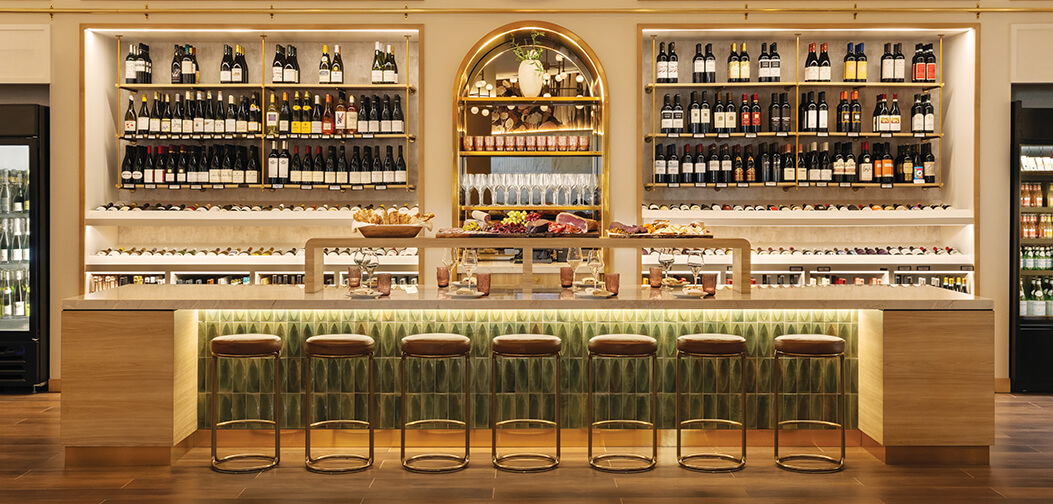
While the promenade focused on activation, the lobby bar centered on perception and inclusivity. He said he has long believed hotel lobby bars must be carefully designed to avoid becoming spaces that feel dark or uninviting.
“I wanted to create a lobby bar that no woman is going to be afraid to go into and sit all night,” he said. The vision included “four o’clock wine gatherings for locals” and consistent programming to bring life to the space.
The result was Wineaux, a wine-focused lobby bar, retail shop and light-bite destination from Chef Shawn McClain and partner Rich Camarota. With its bright design and curated by-the-glass offerings, Wineaux marked the brand’s first hotel-based location and became a centerpiece of the new guest experience.
Programming is ongoing. “They do programming in that lobby bar just about every night,” Colicchio said, citing wine tastings, spirits education and informal cheese talks. The intent was twofold: entertain conference guests and attract the surrounding Summerlin community.
The culinary overhaul unfolded alongside the property-wide renovation, which infused the resort’s Spanish Colonial architecture with modern luxury and wellness touches described as “mindful indulgence.”
Michelle McHugh, GM of the resort and casino, said partnering with Colicchio Consulting allowed the property to reimagine its food and beverage program with the same intentionality applied to the broader transformation. The consulting team immersed itself in the resort’s culture and advised on strategy and innovative deal structuring to balance culinary innovation with loyalty to long-time guests.
Schneck described the property as “one of a kind,” adding that it’s supported by “today’s preeminent culinary leaders.”
For Colicchio, the early accolades earned by several of the new venues are welcome but secondary. “The quality is key,” he said. “But getting the experience right is even better.”
