

As hotel operators confront plateauing room rates, rising operating costs and rapidly evolving guest expectations, food and beverage is emerging as one of hospitality’s most important strategic levers—not only for revenue, but for differentiation, loyalty and long-term stability.
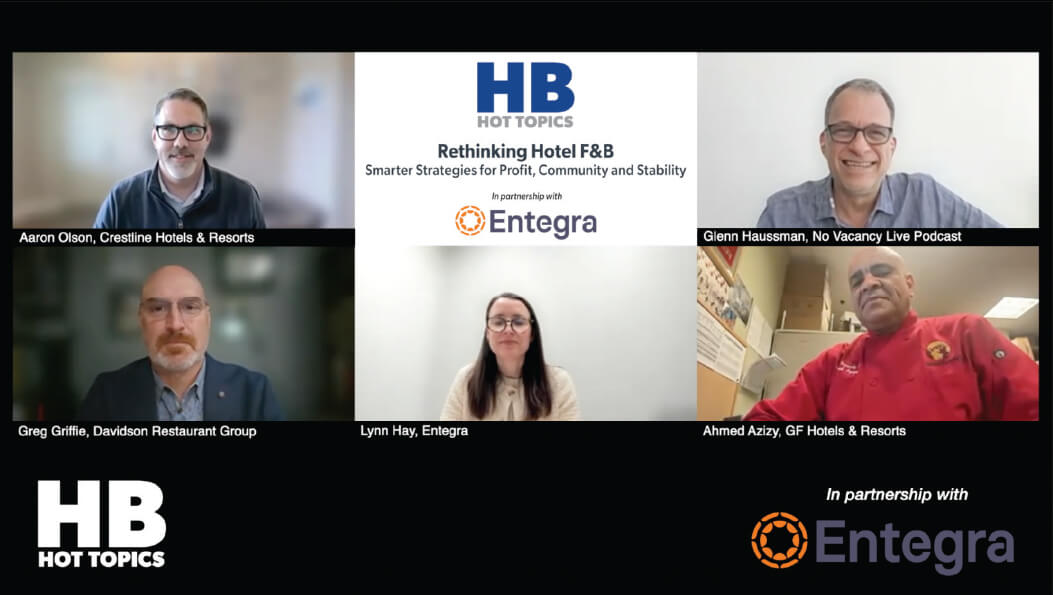
During a recent Hotel Business Hot Topics discussion, “Rethinking Hotel F&B: Smarter Strategies for Profit, Community and Stability,” in partnership with Entegra, a panel of industry experts discussed how hotels are tightening costs, refining procurement strategies and elevating food and beverage into a primary revenue engine, while crafting experiences that engage today’s guests and their communities.
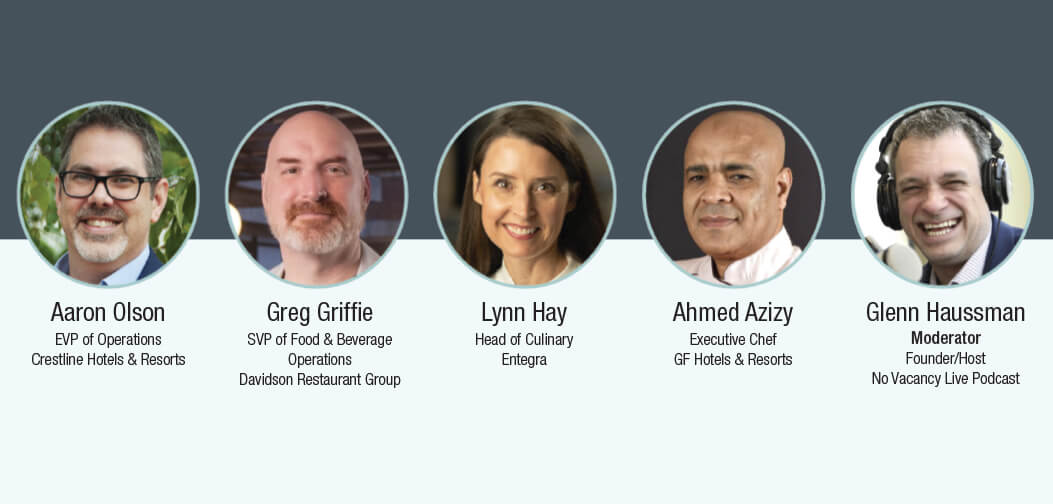
Moderated by Glenn Haussman, founder and host of the No Vacancy Live podcast, the panel included Ahmed Azizy, executive chef, GF Hotels & Resorts; Greg Griffie, SVP, food & beverage operations, Davidson Restaurant Group; Lynn Hay, head of culinary, Entegra; and Aaron Olson, EVP, operations, Crestline Hotels & Resorts.
For operators, today’s environment demands sharper execution and stronger operational discipline. “Our owners are feeling a little pressure out there,” said Olson. “Revenue has not been growing the way that we all would like, and that means more pressure on us operators to deliver stable and hopefully growing profit margins.”
Enter the restaurant as a driver of ancillary revue for a hotel. “This shift from restaurants being less of just ‘OK, it’s just an amenity’ to ‘No, this is a core profit driver’ is one of the most exciting things we’ve seen,” he said. “Guests don’t want to just stay in that beige box. They want an experience.”
For Davidson Hospitality, food and beverage strategy begins with a holistic revenue lens.
“We’re really focused on the TRevPOR—total revenue per occupied room—and using F&B as one of the major drivers of that,” said Griffie.
That means looking beyond traditional restaurant revenue. He noted, “It’s not just our signature restaurants, but where can we add ROI projects to sell soft serve ice cream? Where can we drive and sell the extra coffee? It’s about where we can find the incremental revenue throughout the daypart—capturing the morning, capturing the evening and as they’re moving through the building during the day.”
Meanwhile, changing consumer behavior is reshaping menus. “People may be eating a little less today in today’s GLP-1 world, but they certainly like that premium,” he said. “Can I get black truffles shaved on my steak? Or caviar added to oysters? That helps drive engagement within the social media world, but also drives our check up as well.”
While innovation dominates industry conversations, some operators argue the real opportunity lies in simplification.
“It’s about understanding your client and see what they want,” said Ahmed Azizy, executive chef at GF Hotels & Resorts. “Instead of trying to create things, just get to the point where you understand what the customers want. We customize the menus to their liking and then just keep it simple,” he added. “Let’s not start thinking and move it further than it needs to be.”
However, cost discipline remains equally critical. “There is profit, and then there’s also controlling cost,” Azizy said. “You can be creative, and it doesn’t have to be expensive to create an experience. See what you have in your wallet first.”
Hay said guest experience begins with operational consistency, adding, “Experiences are such a strong motivator. But along with that, experience is creating consistency. It’s really important to create the SOPs and very easy-to-understand training for the team so you are bringing a consistent quality menu.”
Hay stressed the importance of supplier partnerships and data-driven decision-making. “I’m going to encourage the audience to lean out to their GPO partners, particularly the culinary department, as you’re looking to reinvent the F&B within your properties,” she said.
She brought up the statistic that 70% to 80% of people put something in their coffee, noting, “We want to make sure that we’re selecting the right product, and we’re not diluting it, we’re brewing it at the right strength and we’ve got the right level of coffee for the right property. We can make all these decisions in our test kitchen, and you can leave a session like that and understand what the impact is going to be on your bottom line, so that you’re still creating that great beverage experience for the client.”
Feeding is fundamental
Despite new strategies and innovations, Olson pointed out that success often comes down to fundamentals. “We’ve all walked into a hotel late at night where there’s no music playing, the lights are too bright and the TV behind the bar is on something unrelated,” he said. “Those are things completely within our control, and doing the basics well creates a competitive edge.”
Griffie said that the opportunity often begins with making better use of what hotels already have.
“We don’t manage a lot of select-service, but if you have a bar, obviously capitalize on it,” the Davidson executive said. “You can program it out and work with your beverage partners to create a vibe through activations.”
Late-night arrivals, in particular, represent overlooked revenue potential. “If you are serving alcohol, make sure you have the right packaged items for people coming in late at night after a rough day so they can grab a pre-made cocktail or a split of wine,” Griffie said. “And don’t forget to have a freezer with great sweet treats ready for people. Those are incremental sales whether you’re select-service or full-service.”
Across segments, operators are rethinking how retail and grab-and-go offerings contribute to the overall guest experience. “In our full-service coffee shop markets and grab-and-go spaces, we brand them and go all in,” he said.
Balancing familiarity with discovery is key when it comes to grab-and-go markets. “We make sure we have a mix, with at least 25% local favorites alongside national brands people recognize,” Griffie added. “Business travelers don’t always have time to experience the local market, so you need to bring some of that to them. Often you can drive a premium price because it’s something new or something they want to take home and share.”
Azizy noted that emotional connection is just as important as operational strategy. “Food is emotional,” he said. “People are at the hotel away from their families, so you have to make it feel homey. You see people sitting by themselves, and our job is to minimize that feeling and make them comfortable with comfort foods they relate to.”
Creating a distinct identity helps drive repeat business. “Once you have that identity, people remember you and come back,” he said. “Simple things like different lighting between breakfast and dinner are very important. That’s what people remember, and they talk about it and share it on social media.”
Capturing and promoting experiences is equally critical. “Make sure you have the right partners in place from an AV perspective,” Olson explained. “When you create great setups, capture them. Align those shoots with standout in-house events and arm your sales and catering teams with that content.”
Convenience-driven offerings are also reshaping how hotels serve guests, said Hay. “Creating experiences for business travelers is key, and you can do that even in a gift shop environment,” she said. “Something simple like adding quick-cook technology and offering a full pizza that can be prepared in two minutes creates convenience without requiring highly skilled labor. Guests know they can arrive late and still get something familiar—and that brings them back.”
Meanwhile, broader lifestyle trends are influencing menus and product strategy. “The GLP-1 trend is evolving the food and beverage industry, and we need to rethink menus accordingly,” Hay said. “Guests want higher-protein options and flexible portion sizes so they can select what fits their lifestyle.”
Space optimization
Space-efficient solutions are gaining traction as well. “Protein beverages are a quick 20 grams of protein and require very little space,” she added. “Hydroponic gardens, craft cocktails and zero-proof programs create memorable differentiation and keep guests coming back.”
Ultimately, successful F&B strategies start with understanding how guests interact with a property. “We think about the guest journey—how guests move through the space and where the touchpoints are,” Griffie said. “We look for gaps and create offerings to capture those moments.”
At one resort, that insight led to unexpected innovation. “Guests were leaving to get ice cream, so we converted a pool closet into a 325-sq.-ft. soft-serve outlet and turned an old bait shop into a pizza shop,” he said. “That allowed us to capture incremental sales throughout the day.”
These changes, however, cost money, and hotels need to understand what they are already spending and use data to guide decisions.
“There are a lot of tools available through Entegra that help show what you’re spending today and what cost savings you might achieve by moving to contracted items,” she said.
She also noted that analyzing menu performance reveals opportunities operators might otherwise miss. “We work with clients to review their menu mix, identify where they’re up, where they’re down and where the gaps are, and then use that data to help reengineer what a menu might look like,” she said.
While analytics provide direction, operators emphasize that listening to guests remains equally essential. Azizy said successful concepts begin with understanding what customers actually want—and delivering it within realistic financial boundaries.
“To me, it’s always about going back and listening to people—listening to what they want,” he said. “We do surveys and work closely with the marketing team, and the goal is to give customers what they want while making sure you can afford it. You have to be realistic.”
Azizy encourages flexibility rather than rejection when new requests arise. “One thing I tell my staff is I never say no—I just put a dollar sign next to it,” he said. “Tell me what you want, and I’ll see what fits within the budget.”
Changing consumer habits—particularly declining alcohol consumption among younger travelers—are also reshaping beverage strategies. Olson said hotels must ensure inclusive experiences for guests who choose not to drink.
“I’ve experienced dining with owners and colleagues who don’t drink, and the question becomes whether the cocktail experience feels the same for guests who aren’t consuming alcohol,” he said. “A zero-proof cocktail program should be treated with the same level of care and respect as alcoholic cocktails—fresh juices, garnishes and all the same thoughtful touches.”
Griffie sees these evolving preferences as opportunities to expand revenue through creativity and upselling. “We’re also focusing on upsell opportunities for children and younger guests, especially at pool bars,” he said. “We’re adding boba drinks and dirty sodas into banquet menus because guests want something different beyond coffee, tea, water or canned soda.”
Despite changing menus and beverage programs, Griffie noted that operational fundamentals remain largely unchanged. “From a design standpoint, we’re not making major changes because the process of making drinks remains the same—you still need the same stations, refrigeration and workflow whether the drink contains alcohol or not,” he said.
Bringing in the locals
A key opportunity is attracting local audiences—not just hotel guests—through thoughtful programming and community engagement. “We have a client focused on attracting local business during the down season,” said Hay. “They bring in local artists and musicians and create specialty evenings, which has been very successful.”
Those events targeted toward locals can help hotels build year-round traffic while strengthening their identity within the community. “Sunday brunch, jazz nights or pub quiz nights give locals something to look forward to and encourage them to return again and again,” she said. “The goal is to create experiences that attract people from across the community, not just hotel guests.”
For Azizy, successful F&B programs begin with understanding guests while maintaining operational realism. “When designing menus, I think about how to appeal to as many guests as possible,” he said. “Local items help create identity, but you also have to balance them with broader offerings.”
AI in F&B
Technology is also reshaping how operators approach decision-making, though panelists said that tools must support—not replace— hospitality fundamentals. Artificial intelligence, in particular, has quickly become part of daily conversations.
From preparing presentations to organizing operational insights, AI can help teams save time and communicate more effectively. Still, Olson offered, “If food and beverage doesn’t have clear accountability, you’re never going to be profitable. Leaders need strong processes around menu mix reviews, inventory controls and understanding food costs.”
Creating an environment where teams can experiment is equally important. “Often the best concepts come from local leaders who understand their communities,” he added.
Griffie agreed that technology has potential but warned against viewing it as a cure-all. “AI can help us present better and work more efficiently, but it’s not a silver bullet for running a more efficient F&B operation,” he said. “We still need leaders who understand how to manually calculate food costs and run the business.”
Instead, he suggested returning to the basics of operations. “Reduce your waste, don’t overorder and watch your inventory—that’s back to the basics of controlling costs,” Griffie said.
Data-driven tools are already helping operators improve purchasing decisions. Hay pointed to AI-powered platforms that analyze buying habits and highlight cost-saving opportunities in real time. “It helps operators make smarter purchasing decisions without interrupting their workflow,” she said.
As operators rethink food and beverage for a new generation of travelers, the goal is no longer simply serving meals or drinks. Instead, today’s F&B programs are designed to deliver relevance—meeting guests where they are while ensuring profitability remains firmly on the menu.
Key takeaways1. F&B is no longer just an amenityHotel restaurants are shifting from required offerings to core profit drivers that support ADR growth, brand identity and guest loyalty. 2. Think beyond the restaurantIncremental revenue comes from markets, grab-and-go spaces, late-night offerings and underutilized areas—even small expansions can deliver outsized ROI. 3. The guest journey drives strategySuccessful operators analyze how guests move through a property and identify gaps across dayparts where new experiences or outlets can capture revenue. 4. Simplicity often winsMenus built around what guests actually want—executed consistently—can outperform overly complex concepts while controlling costs. 5. Local matters—but balance itA mix of recognizable brands and local products creates discovery while maintaining guest comfort and operational reliability. 6. Experience equals atmosphereLighting, music, service style and design must evolve throughout the day to create distinct identities between breakfast, daytime and nighttime operations. 7. Wellness trends are reshaping menusHigher-protein options, flexible portion sizes and zero-proof beverages reflect changing consumer habits influenced by health and lifestyle shifts. 8. Technology supports—but doesn’t replace—operatorsAI and analytics improve purchasing, planning and communication, but operational fundamentals and human expertise remain essential. 9. Team member experience drives guest experienceProfitability depends on engaged employees, clear accountability and empowering on-property teams to test new ideas. |
