


For decades, the on-premises laundry room was a fixture of full-service hotels and resorts. Today, many owners and operators are reconsidering whether that space still makes financial and operational sense.
According to Pablo Lucchesi, CEO, Crown Linen, the shift away from on-site laundry has been building, driven largely by real estate economics, capital costs and labor pressures. “It had been going on for many years, and it had to do with the cost of real estate and the alternative uses of available space at hotels,” he said.
One of the primary motivations, he said, was the alternative use of valuable square footage. “In general, most hotels decided to dedicate that area for something else rather than a cost center,” he noted. “They were moving away from cost centers to revenue-generating centers.”
In his experience, much of Crown Linen’s growth has come from hotels closing on-premises laundries and repurposing the space.
“I had customers who moved their executive offices to where the laundry was and then turned the former office space into an enlarged spa,” he said. Others have added rooms, treatment spaces or new food and beverage outlets. “I had one hotel that put in a Starbucks because the space was right there on the lobby level,” he said.
In tighter urban markets such as Miami Beach, older properties have used the reclaimed space for storage. Lucchesi noted that storage was often in short supply, affecting everything from linen inventory to bulk purchasing of paper goods and other nonperishables.
“They were struggling because they didn’t have anywhere to put linens,” he said. Additional storage can enable larger orders, which reduces freight frequency and improves operational efficiency.
Hotels have decided to outsource laundry operations when aging laundry equipment needs to be replaced. “That created a lot of complications for a hotel,” Lucchesi said. “It wasn’t only the new equipment that was costly. Taking out the old equipment and rigging in the new equipment was complicated.” In some cases, ownership evaluated the required investment and decided to outsource instead of reinvesting in a new on-site plant.
One challenge in evaluating the in-house vs. outsourced model is accurately determining internal processing costs.
“Utilities are often not separately metered for the laundry, which can obscure the true expense of water, gas and electricity,” he said. “When you divided underestimated costs by inaccurate poundage, your cost was all over the place.”
At the same time, properties may not have precise data on the number of pounds processed, making per-pound calculations unreliable.
To address this, Crown Linen developed an on-premises laundry cost calculator that is also used by the Textile Rental Services Association. The tool helps hotels estimate their actual per-pound processing cost by accounting for labor, utilities, chemistry and production volume.
“In all of the studies that we’ve done over the years, it has always shown that it is cheaper to outsource,” Lucchesi said, adding that the degree of savings varies depending on how efficiently a property’s in-house operation is run. “In some cases, it was significantly cheaper,” he said.
Labor remains a central consideration. Hotels operating on-premises laundries typically carry a fixed staffing level regardless of occupancy. Whether a property is full or running at low occupancy, it must still staff washers, dryers and finishing equipment.
“No matter how many rooms they were selling, they still had a fixed number of employees working in the laundry,” he said.
By contrast, Lucchesi describes outsourcing as a “pay-as-you-go” model. Hotels send out only the soiled linens generated by occupied rooms, aligning laundry expense directly with occupancy levels.
“For them, it was very difficult to flex the labor associated with running the laundry to their occupancy,” he said. “If you have guests, you have soiled linens, therefore you have laundry-associated costs,” he said.
For owners focused on margin management, the ability to convert a largely fixed departmental expense into a variable cost tied to occupied rooms can be attractive.
Outsourcing also shifts certain operational risks to the provider. Lucchesi pointed to extreme weather events such as hurricanes, which can simultaneously disrupt infrastructure and drive occupancy spikes as displaced residents, emergency crews and utility workers fill hotels.
Crown Linen operates multiple facilities across Florida and designs its plants with internal redundancy for utilities such as steam and compressed air. If one plant loses power, “the others could pick up the load and continue to provide uninterrupted service,” he said.
A common perception among operators is that large commercial laundries may be harder on linens. Lucchesi argued that modern tunnel washer systems used in hospitality are designed to be gentler than many conventional washers found in on-premises laundries.
“Tunnel washers were normally better for high-end linens than conventional washers because they had less mechanical action,” he said.
Tunnel systems allow for controlled mechanical action and customized wash formulas by linen classification. They also enable proportional chemical dosing based on actual weight, reducing the risk of over- or under-dosing detergents.
“You could customize the wash formula for each specific type of linen,” he said.
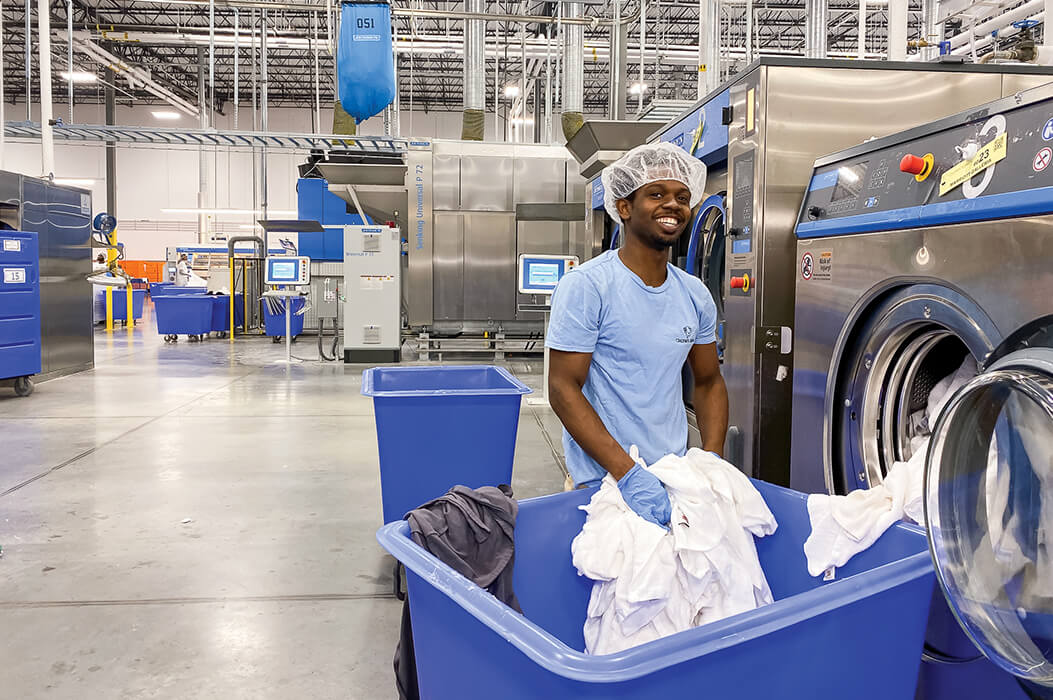
Lucchesi said advanced tunnel systems can operate at roughly one gallon of water per pound of linen, compared to approximately 3.5 gallons per pound for conventional washer extractors.
With water reclamation systems, usage can be reduced further by reusing treated wastewater in subsequent cycles. Lower water volumes also reduce the energy required to heat wash water. “With water reclamation, we were using roughly half a gallon per pound,” he said.
For owners tracking environmental metrics alongside operating costs, these efficiencies may factor into outsourcing decisions.
Lucchesi said that most new full-service and luxury hotels are being developed without on-site laundry facilities.
Limited-service properties that wash, dry and hand-fold sheets without ironing may still operate small on-premises facilities. However, brands requiring pressed sheets, duvet covers and high-presentation bedding increasingly rely on external laundry partners.
For owners and operators evaluating their own portfolios, the decision ultimately rests on capital priorities, space utilization, labor strategy and service expectations.
