

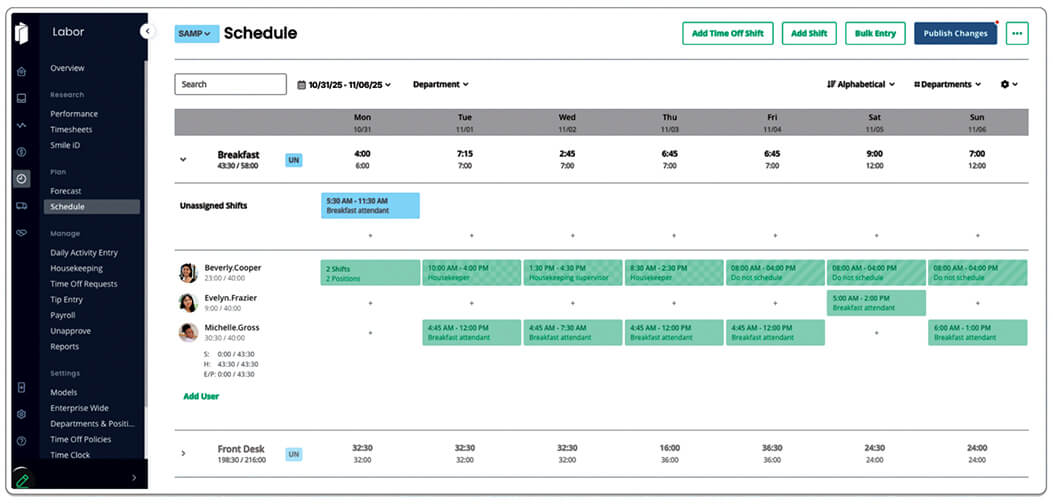
Hotel operators are currently reassessing how effectively their back-of-house systems support day-to-day decision-making. Rising labor costs, tighter lending conditions and increased reporting expectations have exposed gaps created by years of fragmented technology stacks.
According to Steve Leonard, COO, Inn-Flow, many organizations are now confronting how difficult it has become to understand real-time performance across their portfolios.
“We’re coming out of the disruption of COVID and still seeing some staffing challenges, but the focus is shifting,” he said. “Now it’s more about fragmentation across systems and data, and people realizing how hard it is to understand how the business is actually performing.”
Leonard said owners, lenders and banks are playing a growing role in that realization. “There are much higher expectations around financial reporting,” he said. “Revenue pressure is increasing and labor costs are not going down. Labor remains the largest controllable expense.”
Many hotel companies still manage accounting, labor, scheduling and reporting through separate systems, a setup Leonard said creates complexity at both the property and portfolio levels.
“When labor systems don’t talk to revenue or budget data, general managers are being asked to make critical decisions without the full picture,” he said. “They’re expected to run the hotel like a CEO, but they’re not given connected tools to do that.”
Leonard noted that this disconnect forces managers to rely on manual processes to piece together performance data. “Even when hotels do have software, if those tools aren’t connected, managers only have part of the data,” he said. “They end up spending huge amounts of time pulling information into spreadsheets just to understand what already happened.”
Disconnected systems also limit an operator’s ability to plan ahead. Leonard said many organizations remain stuck reviewing historical results instead of anticipating future outcomes.
“We see so many owners pulling payroll data into their finance systems and trying to figure out why they spent too much money two weeks ago,” he said. “That’s not a good place to be.”
When labor, revenue and budget data are integrated, managers can begin to shift from hindsight to foresight. “If I can see what’s going to happen tomorrow instead of two weeks ago, I can react in advance,” Leonard said. “Forecasting and analytics help managers make better decisions about overtime, callouts and scheduling before costs get out of control.”
That forward-looking visibility also affects employees. “Better projections mean more stable schedules,” Leonard said. “You don’t have people sitting around waiting to see if they’re working this weekend. That matters for morale.”
AI and advanced analytics are becoming more meaningful as part of that integrated approach, though Leonard cautioned against treating AI as a buzzword.
“AI can be buzz and BI can be buzz, but what’s actually meaningful?” he asked, noting, “We’re getting access to computing power that can process far more data than humans can and do it faster.”
He pointed to applications such as invoice processing, transaction reconciliation and performance comparisons across similar hotels.
“The AI is doing the analysis faster and telling you where something is off, allowing teams to focus on fixing the issue instead of finding it,” he said.
Leonard said small and mid-sized management companies often lack the resources to manage multiple disconnected tools.
“These aren’t organizations with large IT teams,” he said. “We’ve seen companies buy five different solutions and then realize they don’t have the staff to manage them.”
For those operators, consolidation is critical. “Using one integrated system allows them to focus on running the business instead of managing software,” he said.
He added that the need for integration extends across all hotel segments. “It’s easy to assume this is only for full-service or luxury hotels,” Leonard said. “But budget and economy hotels often have thinner margins and no room for error. In many cases, they need this visibility the most.”
At the center of operational clarity, Leonard said, is trust in the data itself. “If you don’t trust the data, it’s hard to trust the decisions or the teams behind them,” he said. “When everyone is working from the same numbers, conversations shift from debating the data to making decisions.”
Shared visibility can ease owner and investor relationships while improving internal alignment.
“Having immediate, accurate data in one place has been a relief for a lot of teams,” he said.
