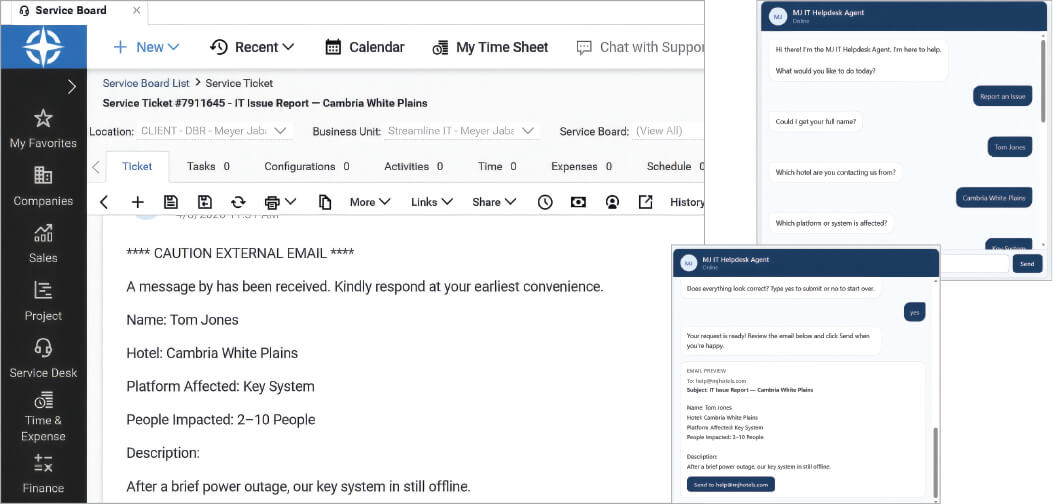
Meyer Jabara Hotels is accelerating its use of AI across nearly every part of the business, with President Justin Jabara saying the company views AI not as a passing trend but as a transformational tool that will reshape hotel operations, leadership roles and long-term competitiveness.
Jabara outlined a company-wide strategy that ranges from finance automation and portfolio analysis to associate support tools and future guest-facing applications. Current deployments are centered on finance and other back-office functions, but the company plans a broader expansion into all departments.
“Our goal by the end of the year is every discipline within Meyer Jabara having a dedicated AI agent working for them,” he said. “That has been my decree to the company. I think it’s what we need to be competitive in the short term, but to be relevant and compete in the long term.”
Jabara said the company believes the hospitality industry is entering a period where AI adoption will separate leaders from laggards. “I feel that at least in the near term, AI is going to give us a competitive advantage against our peers,” he said. “Then, in the long term, I think it’s going to raise the water line of capability of all companies. If you’re not utilizing it, you won’t be able to compete in the world in the future. The bar is rising.”
That shift, he added, will affect employees at every stage of their careers. “AI is going to affect everybody,” he explained. “It doesn’t matter if you’re in your 20s and coming out of college, or if you’re approaching retirement. AI is finding its place everywhere.”
One of the company’s earliest discoveries was that employee familiarity with AI varied widely, according to Jabara. Some team members were already using AI tools regularly in their personal lives, while others had little awareness of how often they were already interacting with AI through navigation apps, music platforms and automated customer service systems.
That realization led the company to make AI a central theme of its annual executive session, which brings together GMs, directors of sales, support office staff and other leaders.
Rather than focusing on hotel operations, the annual gathering is designed around leadership development. “We spent a couple of days together working on leadership, but also AI and how we integrate it into our lives so that we’re more productive,” he said.
One exercise encouraged leaders to ask AI directly how it could improve their work instead of seeing it as a threat. “Instead of wondering and being concerned about how it’s going to take your job, go ask AI how it can help you be better at your role and be more efficient,” Jabara said. “It’s a wonderful activity to do and really eye-opening to some of the capability behind it.”
He said the company is also encouraging employees to identify the tasks AI cannot do and focus on those human strengths. “You can ask AI, ‘What are the things AI can’t do that I, in my role, should focus on and leverage in the future?’” he said. “Because AI can help us be much more efficient. It is wonderful at handling some of these administrative tasks that take a ton of time.”
One of the clearest early applications has been finance, where Jabara said AI is particularly strong at reviewing large amounts of information and simplifying it. The company is rolling out multiple AI agents tied to month-end close processes, P&L reviews, portfolio reviews and executive summaries.
He described a traditional month-end review process that once required days of manual preparation. “I remember coming up in the industry, we’d do a month-end review, and everybody gets into a room,” he said. “It would take two to three days of pulling together P&Ls, pace reports, STR reports, you name it, for every hotel. Then we’d sit in a room and solve the world’s problems.”
He continued, “With AI, that information is analyzed real time. It’s unbelievably shocking how good it is most of the time, unless it’s hallucinating and doing something it shouldn’t.”
The company is also building tools designed for hotel GMs and SVPs. Jabara described a system where a GM begins the day with an AI-generated briefing highlighting overtime trends, pricing opportunities and operational priorities.
Jabara said, “You walk in as a GM, and your AI agent says, ‘Here’s what you have going on in your day. By the way, the front desk is approaching overtime. Look at Friday and Saturday, your rates may not be fully aligned with the pickup.’”
He said those insights currently require managers to review multiple systems and reports.
“The playbook of the day typically takes a GM hours of every day,” he said. “They have to read all their emails. They have to log into their brand systems. They need to log into their sales system. They need to log into the revenue management system. They need to log into our BI system.”
He said that shift allows leaders to spend less time gathering information and more time acting on it. “The SVP or the regional sales manager isn’t taking that time to analyze the issue,” he said. “They’re taking that time to solve it. What are the things we now need to do to solve this? Change course, if need be, or add more resources, whatever it may be.”
Despite the company’s ambitious rollout, Jabara said Meyer Jabara is not removing human judgment from decision-making.
“We have designed our system so there’s always a human in the loop,” he said. “AI does what we would like for it to do, and then there’s a human there going through and analyzing and verifying, because it does make mistakes.”
The president added that data quality remains critical. “It’s only as good as the data,” he said. “If the data is bad coming in, then the mistakes are greater, and then it’s not a productive exercise.”
He cited labor variances caused by unusual events such as storms or outages as examples where human context is still necessary.
“If I was over in front desk payroll because we had a snowstorm with a power outage and I had to double staff, AI doesn’t know what to do with that after taking the information,” he said.
Before expanding use cases, the company focused on governance and infrastructure. Jabara said it first established internal rules around AI usage, privacy and security, then built systems on secured servers with appropriate controls.
“There are a lot of pitfalls to it,” he said. “Your information is secure to varying degrees depending on what systems you’re using. The biggest thing that we started with was, ‘What is the governance around AI use and security? What are the rules of the road?’”
The company also uses outside implementation support alongside internal expertise.
“This is moving too quickly to go it alone,” he said. “There’s a very high level of complexity and risk to doing it wrong.”
While much of Meyer Jabara’s current progress has been internal, the company has also tested guest-facing tools. Jabara recalled receiving a sales call that sounded human, only to learn it was AI representing a hotel service provider.
“Somebody called me on my cell phone and pitched me and then hung up,” he said. “Then somebody called me back and said that wasn’t a real person. That was AI. I am a real person. Now here’s our company.”
He said the product functioned as an AI front desk solution and was “really, really good.”
Still, broad deployment can be difficult for third-party operators managing branded hotels.
“We have 18 different brands within our portfolio, and within that every brand has its own systems,” he said. “If the parent brand isn’t utilizing AI in the PMS or in the revenue management software, we have one hand tied behind our back as to how fast we can move.”
The company is also using AI to improve internal service for associates. One beta tool connects to employee handbooks, allowing team members to ask questions about policies, vacation time or dress code requirements. And it can respond in multiple languages.
“We have a beta test that you, as an associate of Meyer Jabara, can say, ‘What’s my vacation policy and how much vacation time do I have?’” he said. “It will tell you everything.”

Meyer Jabara Hotels
Jabara expects job descriptions across industries to change as AI absorbs repetitive tasks and administrative burdens. “I believe that even by the end of this year, everybody’s job descriptions are going to change and evolve more toward what are the things that AI can’t do that the human element excels in,” he said.
He pointed to relationship-building, emotional intelligence and leadership as examples. “AI cannot sit down with the housekeepers in a hotel and train them, or sit down with guests or take clients out to dinner,” he said.
He also said technology may support creative and commercial work but still lacks instinct and personality. “It doesn’t have taste,” he said. “It lacks personality and trustworthiness because it’s an agent on a server.”
Jabara believes the scale of change may rival the arrival of the internet. “There really hasn’t been a tool this powerful that will shape a generation,” he said. “It’s been here, but it’s really here now.”
For Meyer Jabara, he said, the priority is identifying the best use cases, deploying them responsibly and helping employees adapt.
As Jabara said: “The question becomes ‘How do we embrace it for the future?”