SmartLinen, the Miami-based technology company that provides hotels with a cloud-based software platform that automatically reports linen inventory data, has undergone what Marlon Serbin, VP of sales, calls a “drastic” transformation—not just in scale, but in the very infrastructure of the business.
The platform now tracks nearly one million linen items per month and has surpassed 75 million total item scans, with the 100-million milestone expected within weeks.
“We’re scanning about 15 million items a month,” said William Serbin, president/CEO, SmartLinen. “We started with 10 hotels and now have more than 250 properties in the network.”
The philosophical shift at the core of SmartLinen’s pitch is straightforward but powerful: Stop treating linen as a disposable consumable and start managing it like a depreciating asset with real, trackable value.
“If you’re buying a $10 towel, you should get as much out of that $10 as physically possible,” said Marlon. “For our clients, if a piece doesn’t make it to a certain number of washes and a certain dollar value, the hotel can be reimbursed for the remaining value. They’re keeping more money in their pocket.”
The company’s RFID-based tracking system automates the entire inventory process—items are tracked the moment they arrive, daily reports are emailed to property managers automatically and a mobile app gives staff real-time visibility into exactly where every piece of linen is at any given moment. The desktop version goes even further, letting managers click through to see the precise location of a single item and a timestamped history of everywhere it has been.
None of this requires hotels to change their daily operations. “Hotels don’t change a single thing,” Marlon explained. “They just buy linen as they normally would. The only thing that changes is their actions—based on numbers, not theory.”
SmartLinen’s most ambitious innovation is still rolling out—an AI agent called “Ask Debbie”—that will allow hotel managers to query their linen inventory using plain language, such as “How many towels do I have?” or “What should I order this month?” The agent will answer in real time, drawing on live usage data.
But the feature Marlon is most excited about is Ask Debbie’s purchasing recommendation engine. “You ask it, ‘What should I order this month?’ and it asks back, ‘How much money do you have to spend?’” he noted. “You say $5,000, and it comes back and says, ‘Based on your current usage, what’s in storage and your budget, here’s exactly what you need to buy,’ broken down by SKU and case pack.”
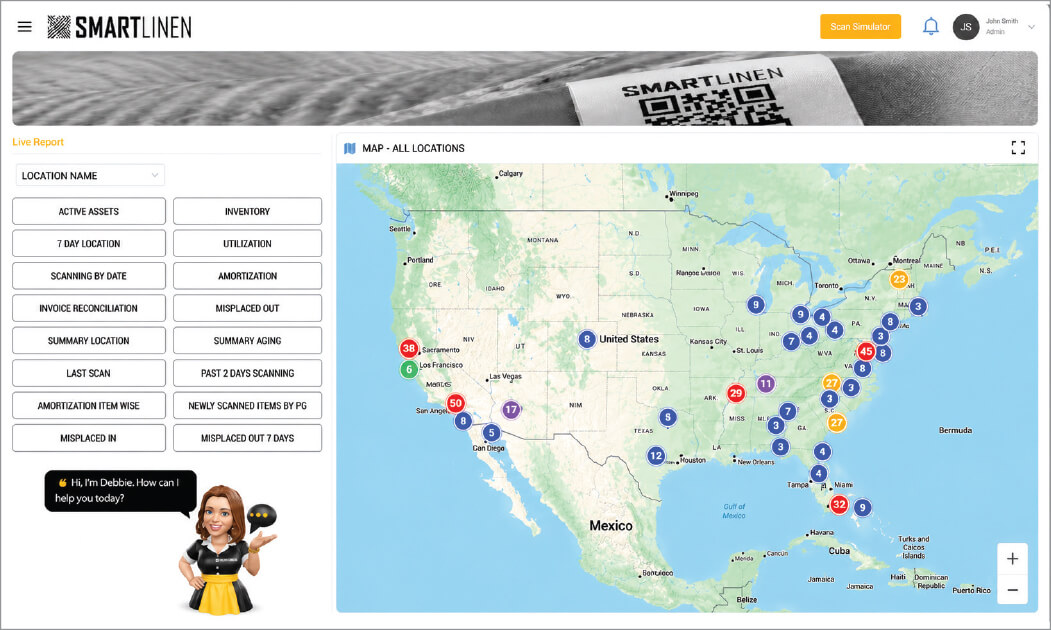
The Serbins are careful to frame the AI as a decision-support tool, not an autonomous purchasing system. “It’s never going to order for you,” Marlon said. “It’s going to say, ‘This is what you should buy—would you like to create a quote?’ The technology is aiding the humans to make the decision.”
One of SmartLinen’s most valuable—and perhaps unexpected—use cases is mediating the longstanding tension between hotels and their laundry partners. Hotels routinely blame laundries for lost linen; laundries insist the problem lies with how hotels circulate their inventory. SmartLinen’s data cuts through the dispute.
“Last year, we were able to recoup about $400,000 to $500,000 in credits for items lost from laundries,” William said. “But we also share the data with the laundries, so they can see it, too. We work as a go-between. The laundry always gets the bad rap, but that’s not always the case.”
In one example, a laundry introduced SmartLinen to one of its hotel clients—essentially volunteering to be tracked—because it wanted to prove it wasn’t responsible for the linen shortages the hotel was experiencing. The data confirmed the hotel’s own inventory circulation was the culprit.
SmartLinen also frames its service as insurance for linen assets. “If our prices are 5% more, that’s the cost of insurance,” Marlon said. “Whatever gets lost, you’re going to get compensated for the difference.”
The company doesn’t just manage linen—it manufactures and sells it, as well. It has introduced a 400-thread-count sheet designed to rival high-end Italian linen vendors, according to Marlon. A luxury towel collection rounds out the offering, with specifications that meet the standards of luxury properties.
SmartLinen’s client list includes Autograph Collection, Curio Collection, Luxury Collection, Hyatt Grand, Hyatt Centric and Hyatt Regency properties, among others. William described the company as “a linen vendor on steroids.”
With a strong footprint across the U.S.—headquartered in Miami with a large presence in California—SmartLinen is now pushing into international markets. The Bahamas and Costa Rica are already in the fold, a Caribbean expansion is underway and both William and Marlon have recently returned from scouting trips, including stops in Europe and Asia.
Perhaps the best indicator of SmartLinen’s momentum is the mediums they still rely on most for growth.
“I pick up the phone and just call the hotel, and we take least two trips a month each,” Marlon said. “It’s as old school as it gets.”