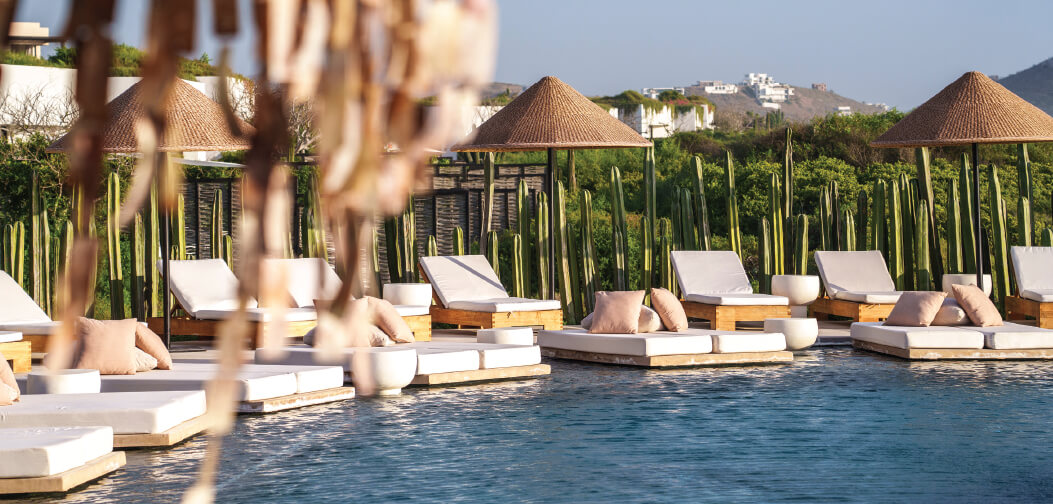
Vacation planning often looks like a checklist: book the flights, map the highlights, squeeze in every restaurant, excursion and attraction possible before heading home exhausted.
Now, many travelers appear to be moving in the opposite direction.
The rise of the “slowcation” reflects a broader shift toward longer stays, lighter schedules and experiences built around presence rather than productivity. Instead of racing through destinations, guests are increasingly looking to settle in, connect with a place and return home restored rather than depleted.
“Guests are increasingly seeking opportunities to slow down, unwind and reconnect with nature, themselves and their significant others,” said Armando Gonzalez, GM, Kimpton Mas Olas Resort and Spa in El Pescadero, Mexico, operated by Remington Hospitality. “We are seeing a clear shift toward more intentional travel, where meaningful experiences take priority over fast-paced itineraries.”
That change is influencing how hotels think about everything from programming and food-and-beverage strategy to staffing models and guest communication.
Traditional leisure travel often revolves around maximizing limited time. Guests arrive with tightly packed schedules, reservations and excursions planned in advance. The modern slow traveler, by contrast, may come with fewer fixed plans and a stronger desire for flexibility.
For hotels, that means creating environments where travelers feel comfortable doing less.
Rather than centering the stay around constant activity, operators are being asked to provide options without pressure, including wellness programming, local experiences and quiet spaces that guests can engage with at their own pace.
“We create gentle touchpoints that invite participation without expectation,” Gonzalez said. “The goal is to guide rather than direct, empowering each guest to shape their own version of a slowcation rooted in mindfulness, well-being and ease.”
That softer approach can be especially important as guests seek vacations that function as emotional resets as much as leisure escapes.
The slowcation trend also places greater value on the setting itself. A destination is no longer just a backdrop for activities. It becomes part of the restorative experience.
Natural surroundings, walkability, local culture and a sense of separation from daily life all help shape a slower rhythm. Remote or immersive destinations may be particularly well positioned because the journey itself can reinforce the feeling of stepping away.
“The destination plays a critical role in shaping the guest experience,” said Gonzalez. “The property’s remoteness, the deliberate effort required to arrive and the surrounding natural beauty all contribute to a sense of disconnection from the outside world.”
That desire to disconnect is increasingly paired with a parallel desire to reconnect with companions, local culture and personal well-being.
One of the clearest operational changes may be in food and beverage. Guests staying longer tend to engage more deeply with dining experiences. Instead of simply eating on property for convenience, they may look for authenticity, sourcing transparency and hands-on participation.
“There is a strong interest in our ‘0 km’ philosophy, where ingredients are sourced directly from the property or nearby,” he said.
That interest has helped fuel experiences such as garden-to-table meals, chef-led preparation sessions and tastings that tell a regional story. In practice, dining becomes less transactional and more experiential.
Hotels across segments can apply that lesson by emphasizing local partnerships, seasonal menus, regional specialties and opportunities for guests to learn or participate.
Longer stays also create different service expectations. Guests who remain on property for several days or more often want the comfort and intuition of residential living paired with hotel-level service. That can affect housekeeping cadence, communication style, personalization and consistency.
“Guests staying longer expect a more residential, intuitive experience,” Gonzalez said. “That means anticipating their preferences and maintaining consistency while offering unique and delicious offerings.”
For operators, this may require more flexible service models and stronger internal coordination. A guest on day six of a stay expects to be known differently than a guest on a one-night booking.
The slowcation trend may also reflect a wider consumer recalibration. Many travelers appear less interested in collecting proof of travel and more interested in collecting meaningful memories.
Gonzalez pointed to a recent wedding group in which guests extended their visits beyond the event itself. What began as a celebration became a longer stay defined by beach walks, spa treatments, shared meals and unstructured time together.
Over time, the focus shifted from the occasion to the experience around it.
That may be the strongest signal of where leisure travel is heading: Vacations built not around squeezing more in, but around getting more out of being there.
As more travelers seek longer and more immersive stays, hotels that can deliver flexibility, authenticity and emotional value may find themselves aligned with a durable shift in demand.