The hotel industry is generating more data than ever, but many operators are still struggling to turn that information into consistent, actionable decisions.
Findings from “The 2026 Hotel Operations Index,” produced by Otelier in partnership with Agilysys and Sage, point to an industry in transition. While 61% of operators say their data is useful, it remains fragmented, and only a small percentage report strong confidence in its accuracy and timeliness.
At the same time, hotel organizations are investing in new technologies, exploring AI and expanding their tech stacks. However, the report makes clear that progress is uneven, and foundational challenges continue to slow the impact of those investments.
For Otelier CEO Rob Lawrence, the importance of data starts with the daily cadence of hotel operations, where decisions are made in real time and directly affect performance.
“At 9:00 a.m., there’s typically a stand-up meeting at a property with the general manager and department heads where they review the results from the day before,” he said.
That review spans the entire operation, from occupancy and ADR to food & beverage performance, maintenance issues and staffing.
“You’re making decisions every day that are impacting your P&L,” he said. “That’s why data is so important.”
Those daily decisions often involve balancing operational efficiency with revenue optimization.
“You’re making sure your back office is doing everything it can to drive an efficient operation,” he said. “At the same time, you’re making daily decisions that can drive different revenue outcomes, like pricing and promotions.”
While the volume of available data continues to grow, Lawrence cautioned against assuming that more data automatically leads to better outcomes.
“The most important thing is that the data is accurate and it’s timely,” he said.
In practice, that means operators need to focus less on collecting additional data points and more on ensuring that existing data is reliable, consistent and accessible when decisions need to be made.
According to Lawrence, closing that gap requires both cultural and operational shifts. “I think one is building the right muscles,” he said. “You need to look at things many times before you get into pattern recognition and can start to derive insights.”
The report identifies fragmentation as one of the most persistent barriers to effective data use, with disconnected systems creating inefficiencies across hotel operations.
Lawrence said that challenge is especially pronounced for multi-property operators managing large portfolios.
“If you’re running 50, 100 or 150 hotels, they’re all running different systems,” he said. “Different payment systems, different point-of-sale systems, different labor systems.”
As a result, generating a comprehensive view of performance requires aggregating and reconciling data from multiple sources, often daily.
“A lot of hoteliers spend an inordinate amount of time chasing their tail trying to reconcile disparate data sets,” he said. “Data is not arriving in a timely manner, it’s not clean and it’s not stable on a daily basis.”
The report quantifies that burden, noting that many operators still rely on manual reporting processes and spend significant time each week consolidating data.
Lawrence described that effort as both resource-intensive and limiting. “You’ll have a dozen people on your finance team, and all they’re doing is chasing data and building spreadsheets,” he said. “That’s probably the biggest blocker.”
The consequences extend beyond inefficiency. When data is delayed or inconsistent, operators often revert to reactive decision-making or rely on intuition rather than analysis.
Fragmentation also creates challenges in standardizing key performance metrics. “If one system defines RevPAR one way and another system defines it slightly differently, how do you do an apples-to-apples comparison?” he said. “You need a data model that can normalize those things.”
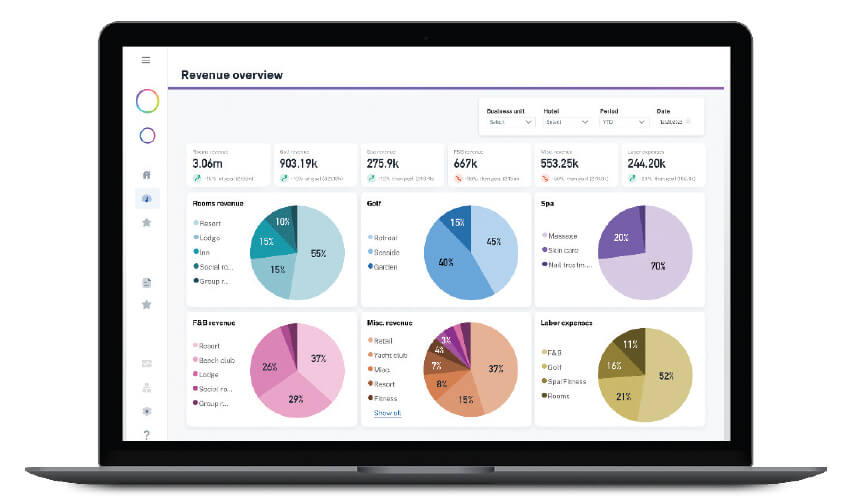
Without that normalization, confidence in reporting erodes, making it harder for leadership teams to act decisively.
Despite these challenges, the potential upside of effective data use is significant, particularly in an industry with tight margins. Lawrence pointed to revenue optimization and cost control as the two primary areas where data can have an immediate impact.
“It’s optimization and revenue maximization,” he said. “What are we doing on a daily basis to drive cash reconciliation and make sure we’re not losing money, and how are we driving higher revenue?”
Labor remains the top operational challenge identified in the report, with staffing, training and cost pressures continuing to weigh on operators.
Lawrence sees data and automation as key tools in addressing those pressures, though not as replacements for human staff. “I think it comes down to automation,” he said. “Doing everything you can to drive efficiencies is critically important.”
At the same time, he emphasized that technology should enhance, not replace, the human element of hospitality. “The human element is always going to be a central piece of hospitality,” he said. “A bot is never going to deliver a rich guest experience like a human can.”
Instead, automation can shift staff time away from repetitive tasks and toward guest-facing activities that drive satisfaction and loyalty.
“That doesn’t mean fewer people working,” he said. “It means people working on more value-added things.”
Interest in AI is growing across the industry, but the report shows that readiness remains limited, with many operators hesitant to adopt AI without stronger data foundations.
Lawrence said that hesitation reflects both practical and cultural factors. “Hospitality has historically been a laggard industry when it comes to tech adoption,” he said. “We’re not where other industries are, and that includes AI.”
He also noted that AI’s effectiveness depends heavily on the quality of underlying data, adding, “If your data isn’t clean and integrated, you’re going to amplify existing issues rather than solve them.”
Still, he sees clear opportunities for AI to improve efficiency, particularly in back-office functions such as finance and reporting. “The speed of what we’re able to do now vs. two years ago is dramatically different,” he said. “We’ve gone from closing our books in 15 days to thinking we can get it down to three.”
Those gains, he added, can have ripple effects across the organization by freeing up time for more strategic work.
For operators looking to become more data-driven, Lawrence recommends a structured approach. “If that is your aspiration as a business, you have to break it down into people, process and tools,” he said.
That includes identifying the right skills, defining clear use cases for data and investing in tools that support those objectives. He noted, “What are we trying to evaluate? Is it profitability, operations, expense management or revenue? You must be clear on the use cases.”
From there, organizations can begin building toward a more mature data strategy, often through a phased approach. “It’s really a data journey,” he said. “You can think about it as a maturity model.”
As the industry continues to evolve, Lawrence expects the gap between data-driven operators and those relying on traditional approaches to widen.
“If you take two similar properties in similar markets, and one has a mature data strategy and the other doesn’t, you will very quickly see a performance difference,” he said.
In an environment where margins are thin and competition is high, that difference can determine long-term success. “You could see a 200-basis-point improvement in profit just by leveraging data more effectively,” he said.
For Lawrence, the conclusion is simple. “I don’t know how you make decisions any better than being informed by operational data,” he said. “Otherwise, you’re doing it on intuition. You might get lucky every now and again, but it’s not a winning strategy.”