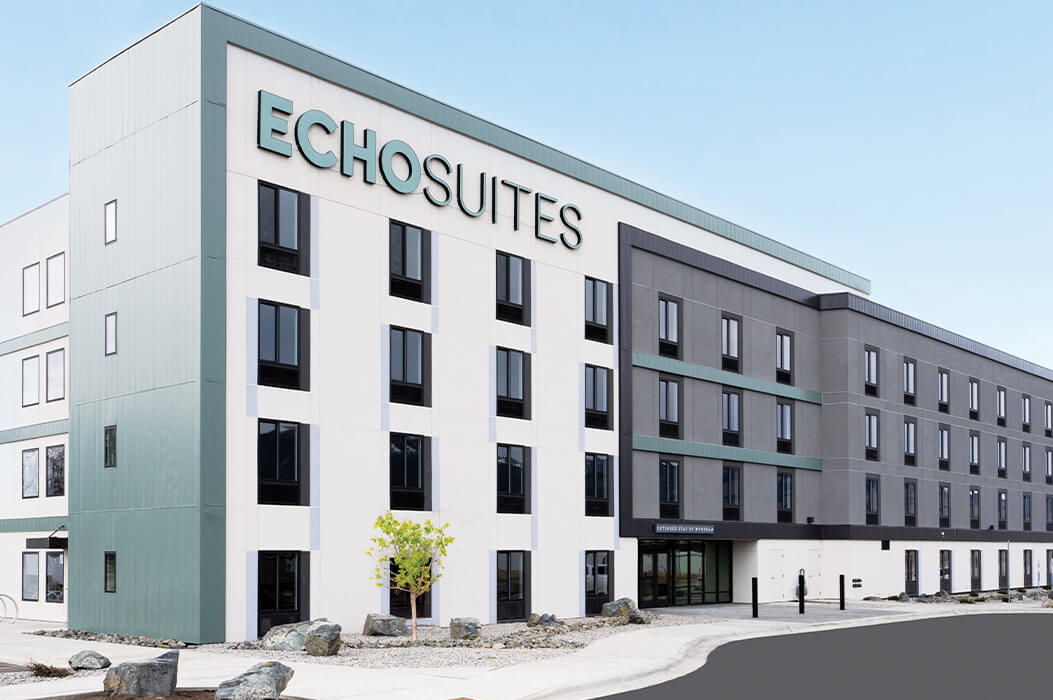
When the 20th ECHO Suites Extended Stay by Wyndham property opened in Bozeman, MT, opened earlier this month, it marked more than another ribbon-cutting for the brand. It represents a turning point for a brand that has moved from early-stage development to a growing national footprint in just a few years.
For Mike Mueller, who assumed leadership of Wyndham’s extended-stay segment last July, the brand’s progress is tied directly to its ability to grow quickly while refining its model.
“The number-one thing was to help grow all the brands in the segment,” said Mueller, president, ECHO Suites Extended Stay by Wyndham. “ECHO was our first new-construction brand that was organically developed by Wyndham since we introduced Wingate in the 1990s. It was an exciting opportunity to come in at the ground level and drive it to critical mass.”
At the time Mueller took over, seven ECHO properties were open. The brand’s expansion to 20 locations in a relatively short period reflects what he described as a “genesis phase” evolving into a more established platform.
From its earliest days as “Project ECHO”—a name derived from “economy hotel”—the brand was developed in close coordination with experienced extended-stay developers. That partnership continues to shape both the physical product and the operating model.
“We didn’t want to go it alone,” Mueller said. “Our owner-first culture really came to life in that we partnered with some of the bigger developers to understand what the market needed.”
That collaboration has resulted in a prototype that is continuously refined. The developers and Wyndham meet regularly through a franchise advisory council to review design, construction and operational feedback. “Every time that we build another ECHO with these developers, we learn and we pivot,” Mueller said.
Adjustments have ranged from infrastructure decisions—such as planning for future technology needs within wall systems—to more visible elements like exterior lighting placement. Guest feedback has also influenced changes, including increasing the number of towels provided in-room and moving from apartment-size to full-size refrigerators to better support longer stays.
The brand has also standardized certain elements over time. “We brought in WynDry terry towels and our WynRest sheets and linens,” Mueller said. “Those were examples of where we could standardize and achieve pricing economies on behalf of our owners.”
Performance metrics indicate the brand is attracting its intended guest base. According to Mueller, more than 70% of guests are staying longer than seven nights, while roughly half are staying more than 60 nights. “This is exactly the way the model was intended to work,” he said.
The prototype itself has remained largely consistent. Most of the brands hotels are approximately 50,000 sq. ft. with 124 rooms, a configuration developed in partnership with institutional developers.
“There only one hotel, located in Reno, NV, that’s 100 rooms,” Mueller said. “That’s an example of our owner-first approach.”
At the same time, construction costs have begun to stabilize. “We saw about a 5% reduction in the cost to build an ECHO in 2025 than it was in 2023 and 2024,” he said, noting that labor costs have been a primary driver of that decline.
The brand has 14 projects currently under construction, with most expected to open this year. An additional dozen projects are scheduled to break ground in 2026, with more in earlier planning stages.
Mueller said the company expects to end 2026 with between 30 and 35 open hotels, followed by another 15 to 20 openings in 2027. “It’s a pivotal moment for us,” he said. “Getting to our 20th opening takes us really from concept to getting to critical mass that gives the brand a sustainable lifespan.”
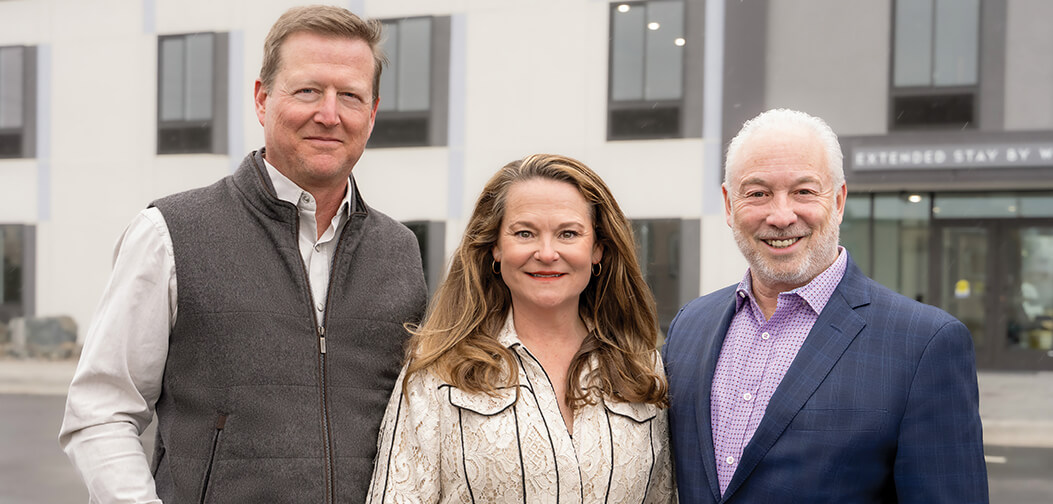
The Bozeman property was developed by Paige York and Casey Tippens, principals of York Development, marking their first hotel project.
For Tippens, the decision to pursue the extended-stay segment was driven by both market conditions and the model’s performance.
“Learning about the extended-stay model and how well it did during the pandemic really attracted us to this type of hotel asset,” he said.
The hotel is located within a newly developed, rail-served industrial park designed to support manufacturing and commercial users.
“This is the first new industrial park in Bozeman in close to 100 years with rail service,” Tippens said. “It’s really attracting a lot of manufacturing and giving a place for Bozeman’s industrial base.”
That environment creates a built-in customer base, particularly among construction and project-based workers. “This is a big construction market… with a lot of out-of-town traveling construction companies,” he said.
York said the project represents a long-held interest in hospitality that aligned with the right concept. “We had always wanted to be in the hospitality space, just never found the right opportunity,” she said. “The efficiency of the model and the design sensibilities really won me over.”
To operate the hotel, the ownership group partnered with Level 5 Hospitality. “We know the market extremely well,” said Paige Burpee, the company’s EVP – sales and marketing. “There’s opportunity in the purpose-built economy space like this property.”
Sales efforts have centered on core demand drivers. “We’re really focused on construction, workforce housing and healthcare,” Burpee said. “Most of our guests are going to be with us 14 or more nights.”
For Mueller, the brand’s ability to adapt—both in design and operations—remains central to its growth.
From refining the timing of pre-opening sales efforts to leveraging technology for reservation extensions and upselling, the model continues to evolve alongside its developers. “What’s really interesting is the partnership that we have with these developers,” he said.
York echoed that sentiment, pointing to the collaborative nature of the development process. “Wyndham put everybody in a room and literally, down to the light fixture, it was a super-collaborative process,” she said. “Our opinions mattered.”
The Bozeman owners indicated interest in expanding their hospitality footprint, with a preference for continuing with the ECHO brand. “We’re pretty loyal to the brand at this point,” York said. “We would love to do more.”
At the property level, there is also an opportunity to incorporate localized elements that reflect the surrounding community—an approach seen as particularly important for extended-stay guests.
“I’m a firm believer in creating a sense of place,” Mueller said. “We give you the blueprint that makes it an ECHO, and then you add the touches that make it your ECHO.”